Written by Steve McQueen, Alpine Agronomy Manager.
With March now upon us, we do not get to choose whether it arrives like a lamb or a lion. This is out of our control, as is the weather throughout each growing season. What is in our control is taking our 2023 lessons and applying our experiences to the 2024 crop plan. As you read some of my articles, you will see this pattern of “learn, unlearn and re-learn.” As we do, we can then better understand the points of influence that we can utilize to develop yearly gains. I trust as you read this article that you look past the information and capture a few ideas to include in your 2024 decision making.
By considering points of influence, we want to enhance germination, unify emergence, and then drive vegetation. During these steps, we need to understand the nutrient requirements, and provide a constant supply of balanced fertility. By developing the best foliage, we can capture maximum sunlight, amplifying plant energy. This energy will be the key to supporting reproduction and then fill. As this is not rocket science, I want to challenge you with a few discoveries that I have considered throughout 2023 research plots.
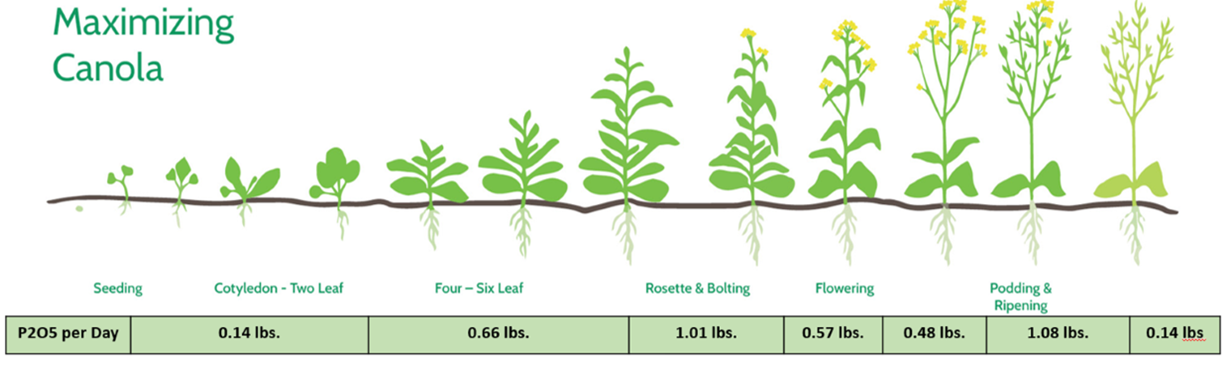
One of my first thoughts was, do we know the rate of N, P, K taken up each day throughout the growing season? To simplify this, do we know what nutrients are required in each of the four stages? By understanding these uptake curves, we can better understand applications to match our crops needs. (Canola example below)
A second thought was, where do we place our fertility, and is it available throughout the growing season? Knowing that roots may only encounter 1% of the soil in the growing season, we must position fertility for maximum uptake. Broadcast vs. Banded, and In-Furrow vs. 2×2, as well as strip-till and side-dress vs. Y-Drop. Each one of these applications requires nutrient solubilization, as well as root interception and mass flow. Each one of these applications relies on water to assist with their success.

This led me to a third discovery, where does the plant acquire water from throughout the season. With some assistance from Crop Intelligence, we were able to monitor water consumption at each stage of growth. This was an aha moment as water consumption was measured over a 1-meter depth, providing some interesting findings. Knowing where the crop is drinking compared to available fertility has opened a bigger learning experience, which begs the question of nutrient availability.
With our fertility based in the top 6”, we are in great shape for germination and the beginning of vegetation with 70-80% water being consumed from that area. As we continued into a higher fertility demand curve, the water consumption began to move down to the 6-12” depth, which begins to decrease water uptake from the core fertility zone. As we completed vegetation and started reproduction, we were dropped to under 35% of the water coming from the rich fertility area, and more from a depleted fertility zone. This led to tissue samples being collected to make sure plants were sufficiently supplied.
These tissue samples became a telling tail, that may lead us to yield decline. Even though the newest complete leaf was tested sufficient, the lower leaves of the plant were declining due to cannibalization. The Crop Intelligence Team continued to monitor plants, and if they had only taken the upper tissue samples, it would be thought that all is ok!! By comparing the upper and lower plant growth, the lesson learned was that the roots were providing water for plant growth, but not adequate fertility due to positioning. If we begin cannibalization prior to filling, we are leaving yield on the table. Although there is a very in-depth story here, I challenge you to pay closer attention to your plant growth, along with fertility utilization this year. So much to learn and we need to capture every lesson we get.
If you have further questions, please reach out to your ALPINE DSM’s and Dealers, and I wish everyone a safe and prosperous 2024 growing season ahead.