Written by: Meghan Moran, OMAFRA Canola and Edible Bean Specialist
Canola producers in Georgian Region are likely familiar with the high sulphur requirements of the crop. Acres of winter canola are on the rise in Ontario, which has raised some questions about the different forms of sulphur and when to apply them. Generally speaking, what we know about sulphur needs in spring canola can be adapted to the fall planted crop.
How much sulphur does canola need?
Canola uses 0.5 to 0.7 lb of sulphur per bushel of yield. A 44 bu/ac crop (1 mt/ac) requires 22 to 31 lb/ac of available sulphur, and many spring canola growers in Ontario report that they are applying about 20 lb/ac of actual sulphur. Accredited sulphur soil tests from which recommendations can be made are currently not available because of a lack of local calibration data, but even where soil levels are sufficient the crop will likely respond to applications of sulphate.
Canola plants take up nitrogen and sulphur in a ratio of approximately 5:1, and high rates of nitrogen applied without sulphur can result in very poor crop performance. If deficiency symptoms are noted, sulphur can be applied as a rescue treatment prior to pod development. However, the clearest visual symptom is small, pale coloured flowers (see photo) and by the time they are observed yield loss may have already occurred. Other symptoms, such as cupped, purple leaves maybe difficult to correctly identify because purple colouring is a common symptom of various stresses and deficiencies.
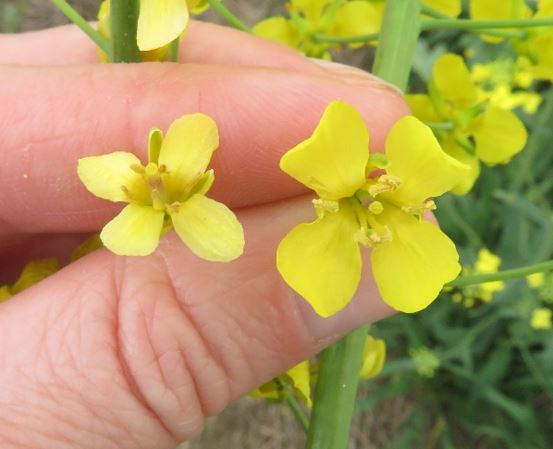
Sulphur deficient canola may have small, pale flowers.
Sulphur is rapidly taken up during the first few weeks of growth, as shown in research conducted in Canada on spring canola (see graph). Because it is the same species as spring canola, winter canola has the same high requirement for sulphur in the early growth stages.
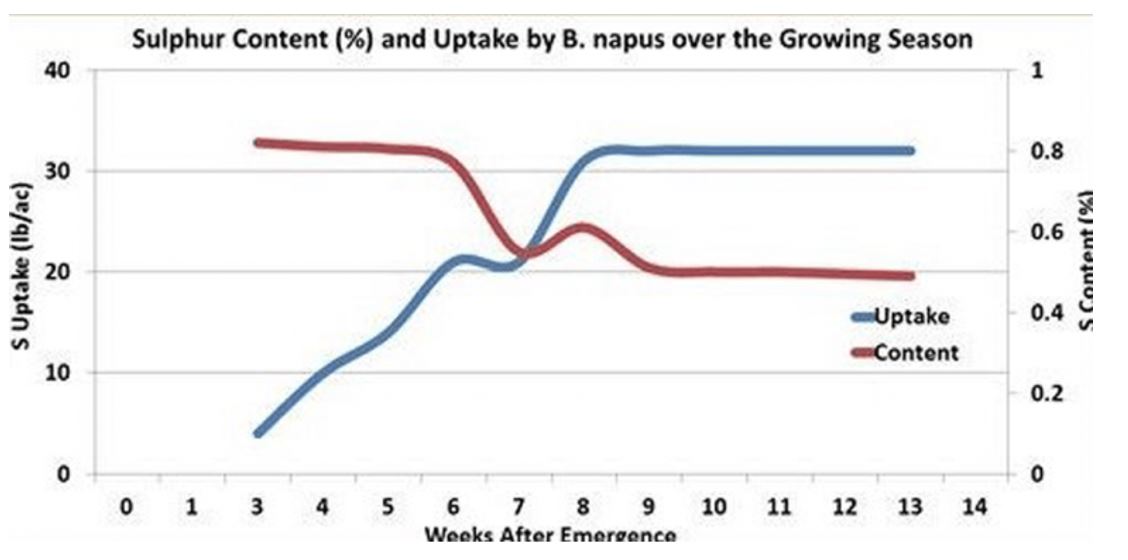
Credit: Canola Council of Canada
How and when is sulphur applied in spring and winter canola?
Sulphur-containing starter fertilizers such as MESZ are becoming common, but canola cannot tolerate much fertilizer in the seed row and the amount of sulphur in starters is not enough. The bulk of the required sulphur is applied along with the nitrogen fertilizer in both spring and winter canola.
In Ontario spring canola production, sulphur is often applied as ammonium sulphate, Amidas, or other granular products which are mixed with MAP and broadcast ahead of seeding. As stated before, 20 lb/ac of actual sulphur is often enough to meet the yield potential of spring canola.
Sulphur fertilizer is also broadcast ahead of seeding winter canola but sulphate will leach through the winter, so it is best to split-apply the sulphur in the fall and spring to meet the crop’s needs and mitigate losses. In Ontario the general recommendation for winter canola has been to apply a total of 30 lb/ac of sulphur, split between fall and spring applications. Research on this topic is a priority.
Although higher yields are certainly possible, the yield goal for winter canola in Ontario is about 70 bu/ac which requires 35 to 49 lb/ac of available sulphur. There is no local data on the best rates for fall and spring split application. Considering there is at least 6 weeks of growth in the fall where sulphur is required, applying at least 10 or 15 lb/ac of actual sulphur ahead of seeding is appropriate. The rest of the sulphur required to meet crop needs is then applied in spring along with the bulk of the nitrogen, prior to bolting (stem elongation). In the spring, both liquid and granular forms of nitrogen and sulphur fertilizer are generally safe to apply to the crop. Many producers report that they prefer dribbling on liquid fertilizers in spring.
Can elemental sulphur be used?
Elemental sulphur must be converted to sulphate by soil microorganisms before it is available to plants. The amount of time this takes depends on the size of the fertilizer prills, moisture level, and temperature. Some research suggests it can take 2 or 3 years before elemental sulphur is available to the crop. It may be beneficial to apply elemental sulphur to build soil levels through the rotation, but it is unlikely to bring value to a canola crop grown in the year of application.