By Christine O’Reilly, OMAFRA Forage and Grazing Specialist, and James Byrne, OMAFRA Beef Cattle Specialist
When grass growth is slow, grazing managers should protect pasture yields by slowing down pasture rotation. This can be done by increasing the rest period for each paddock.
Maximizing pasture yield requires management. One of the most important decisions a manager can make is to give their grass enough time to fully recover after being grazed. Pastures have fully recovered from a grazing event when the grass plants have 3-4 green leaves. At this stage they are palatable, nutritious, and have had time to store energy in their roots and lower stems to fuel regrowth the next time they are grazed.
Sometimes pastures do not recover from grazing as quickly as producers would like. Often this happens when there is a lack of sunlight, cold conditions or not enough rainfall. In these situations, grazing managers should look for ways to slow down their rotation. There are two ways producers could slow down their rotation: add acres to the grazing platform or feed supplemental forage.
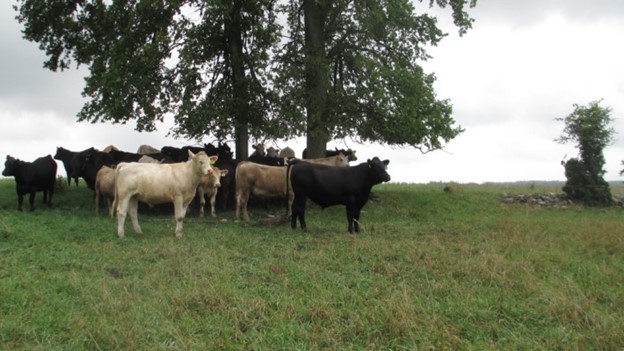
Figure 1. Cattle grazing in field
Add acres to the grazing platform
Increasing the acreage being grazed enables producers to give each paddock a longer rest. Grazing a hay field is one option, particularly if the yield potential of the next cut is low. In these situations, it may be difficult to justify the cost of running equipment across the field, even though the crop must be harvested to prevent the plants from reaching maturity. Once forages set seed, their regrowth potential is less than if they are maintained in the vegetative growth stages. While many producers normally take a first cut and graze the regrowth, consider changing the order in which these are done to maintain yield potential and forage quality. The decision to graze a designated hayfield must account for the likely impact on future winter hay supplies. Consider the yield potential of that hayfield against the cost of providing stored forage on the existing grazing platform.
Annual crops are another way to increase the size of the grazing platform. Cereals and Italian (annual) ryegrass can be managed much like perennial grasses in a managed grazing system, although the amount of regrowth depends very much on rainfall. Warm-season grasses, like sorghum-sudangrass or millet, can also be grazed.
Keep in mind that the grazing of small grain cereals or warm season annuals requires planning, (as these crops must be sown and allowed several weeks to grow before grazing), and so are best used in situations where forage shortages are expected.
Because sorghums, sudangrass, and their hybrids produce prussic acid when stressed, these grasses need to be strip-grazed with a back fence to prevent livestock from eating the new regrowth before it is 60 cm (24 in.) high.
Often expanding the grazing platform involves using fields that do not have livestock infrastructure in place. For cattle, a semi-permanent exterior fence can be constructed from high-tensile wire and T posts, then subdivided using reels of polywire and step-in posts. For sheep, electric netting or multiple strands of polywire are options. Regardless of species, producers need to train their livestock to the electric fence before putting them onto these fields, and make sure that the fences stay hot the entire time livestock are grazing.
While water trucks are a labour-intensive option, they are often the cheapest way to bring water to livestock on fields without infrastructure. Depending on the field, it may be possible to run temporary, above-ground water lines from a well source, or pump from a body of water. Each situation is unique, so producers must cost out the options available to them.
Feed supplemental forage
It may seem counter-intuitive to protect forage inventories by feeding stored forage on pasture. But if the goal is to maximize the amount of forage grown on the farm, sometimes this is necessary to prevent overgrazing, protect pasture yield, and to provide livestock with enough feed to meet their nutritional requirements. The trick to making this work is to be proactive about feeding forage and use it as a tool to slow down the rotation. Waiting until the pasture has run out of grass results in feeding more stored forage overall.
The amount of stored forage that needs to be fed depends upon the daily feed requirements of the livestock and how quickly your pastures are growing. Pasture growth rate will determine how long you need to feed and the total amount you require. It is important to have a good estimate of the bodyweights of the animals on your farm to determine the daily forage requirements.
Where feeding supplemental forage is a short-term solution to a short-term problem, the impact on livestock should be minimal and no additional feed, apart from the supplemental forage, will be required. But if the lack of available pasture is a more long-term problem, it may be necessary to divide the herd or flock up into smaller management groups and adjust the feeding program to match each group’s needs as efficiently as possible.
Tips:
Forage brassicas contain lots of protein and very little fibre, so are best planted in a mixture with grasses or cereals to prevent bloat.
Avoid the temptation to feed old musty forage. This will create more problems than it solves. In addition, animals should have access to clean water, salt and mineral to maintain good health.
Weather Data
| Location | Year | Weekly May 3 – 9, 2021 | Accumulated | |||||
| Highest Temp (°C) | Lowest Temp (°C) | Rain (mm) | Rain (mm) April 1st | GDD 0C April 1st | GDD 5C April 1st | CHU May 1st | ||
| Harrow | 2021 | 19 | 2 | 22 | 60 | 347 | 180 | 77 |
| 2020 | 23 | -3 | 0 | 63 | 273 | 108 | 71 | |
| 2019 | 24 | 4 | 20 | 162 | 356 | 169 | 92 | |
| Ridgetown | 2021 | 19 | 0 | 14 | 52 | 311 | 153 | 67 |
| 2020 | 23 | -5 | 0 | 54 | 223 | 71 | 54 | |
| 2019 | 23 | 5 | 26 | 162 | 323 | 143 | 88 | |
| London | 2021 | 16 | 0 | 8 | 69 | 302 | 150 | 52 |
| 2020 | 19 | -2 | 0 | 65 | 219 | 69 | 47 | |
| 2019 | 22 | 3 | 36 | 163 | 275 | 115 | 84 | |
| Brantford | 2021 | 14 | -1 | 7 | 74 | 284 | 129 | 50 |
| 2020 | 20 | -5 | 1 | 65 | 222 | 74 | 51 | |
| 2019 | 22 | 3 | 32 | 158 | 272 | 115 | 80 | |
| Welland | 2021 | 17 | 1 | 5 | 42 | 298 | 140 | 58 |
| 2020 | 21 | -3 | 3 | 79 | 229 | 77 | 43 | |
| 2019 | 26 | 4 | 44 | 151 | 299 | 131 | 88 | |
| Elora | 2021 | 13 | -2 | 9 | 61 | 257 | 109 | 34 |
| 2020 | 17 | -6 | 1 | 41 | 182 | 50 | 34 | |
| 2019 | 20 | 3 | 20 | 168 | 225 | 82 | 64 | |
| Mount Forest | 2021 | 14 | -2 | 14 | 69 | 262 | 117 | 33 |
| 2020 | 16 | -6 | 4 | 47 | 168 | 44 | 25 | |
| 2019 | 19 | 0 | 4 | 129 | 220 | 81 | 70 | |
| Peterborough | 2021 | 14 | -1 | 6 | 68 | 248 | 92 | 34 |
| 2020 | 19 | -5 | 1 | 65 | 192 | 51 | 50 | |
| 2019 | 22 | 1 | 33 | 152 | 237 | 84 | 67 | |
| Kingston | 2021 | 14 | 1 | 16 | 80 | 274 | 113 | 26 |
| 2020 | 20 | -4 | 6 | 108 | 226 | 72 | 53 | |
| 2019 | 18 | 2 | 25 | 153 | 268 | 104 | 63 | |
| Kemptville | 2021 | 16 | 2 | 9 | 73 | 299 | 137 | 39 |
| 2020 | 22 | -3 | 2 | 75 | 196 | 52 | 49 | |
| 2019 | 23 | 1 | 8 | 115 | 247 | 95 | 63 | |
| Earlton | 2021 | 14 | -2 | 5 | 29 | 223 | 84 | 12 |
| 2020 | 12 | -6 | 2 | 60 | 83 | 10 | 19 | |
| 2019 | 19 | -3 | 29 | 131 | 89 | 11 | 26 | |
| Sudbury | 2021 | 13 | -1 | 23 | 68 | 218 | 81 | 12 |
| 2020 | 14 | -6 | 13 | 76 | 112 | 17 | 22 | |
| 2019 | 19 | -2 | 24 | 120 | 118 | 20 | 33 | |
| Thunder Bay | 2021 | 11 | -4 | 12 | 95 | 157 | 31 | 19 |
| 2020 | 14 | -7 | 0 | 11 | 112 | 26 | 39 | |
| 2019 | 17 | -5 | 18 | 87 | 114 | 18 | 23 | |
| Fort Frances | 2021 | 14 | -5 | 3 | 90 | 170 | 38 | 44 |
| 2020 | 16 | -8 | 0 | 25 | 138 | 35 | 33 | |
| 2019 | 14 | -6 | 6 | 50 | 133 | 28 | 15 | |
| Report complied by OMAFRA using Environment Canada data. Data quality is verified but accuracy is not guaranteed. Report supplied for general information purposes only. An expanded report is available at www.fieldcropnews.com. | ||||||||