Back to Innovator ~~~ Previous article
By Mary Feldskov, Heartland Regional Communication Coordinator
At the Huronview Demonstration site near Clinton, the Huron Soil and Crop Improvement Association (HSCIA) have made big investments of time, energy, and talent to adopt best management practices and trial new and innovative agricultural techniques.
The Huronview site, located south of Clinton along the Bayfield River, is owned by the County of Huron. It was formerly a ‘House of Refuge’ in the 1800s—a working farm for the County’s poor, elderly, and disabled residents. In the later 20th century, Huronview became home to the County’s Long Term Care Home, Huronview Home for the Aged, with the remaining 47 acres rented to local farmers on a three-year rotation. In 2015, Huron SCIA entered into a 10-year partnership with the County. With the benefit of a long-term lease, they are working to rehabilitate the land and “demonstrate sustainability in action” to find new ways to build soil health, achieve the best possible yields, and protect downstream water quality.
Examples of sustainable practices include planting grassed waterways over the gullies that had formed down slopes, planting cover crops, and transitioning to a continuous no-till system to build soil health and aggregate stability therefore reducing erosion and nutrient loss in the Bayfield River and Lake Huron. The biggest investment was in an innovative drainage demonstration project in 2019, installing contour and controlled drainage. While agronomists and specialists track the impact of these initiatives on yield and profitability, the Ausable Bayfield Conservation Authority has partnered with HSCIA to monitor the impacts on water quality.
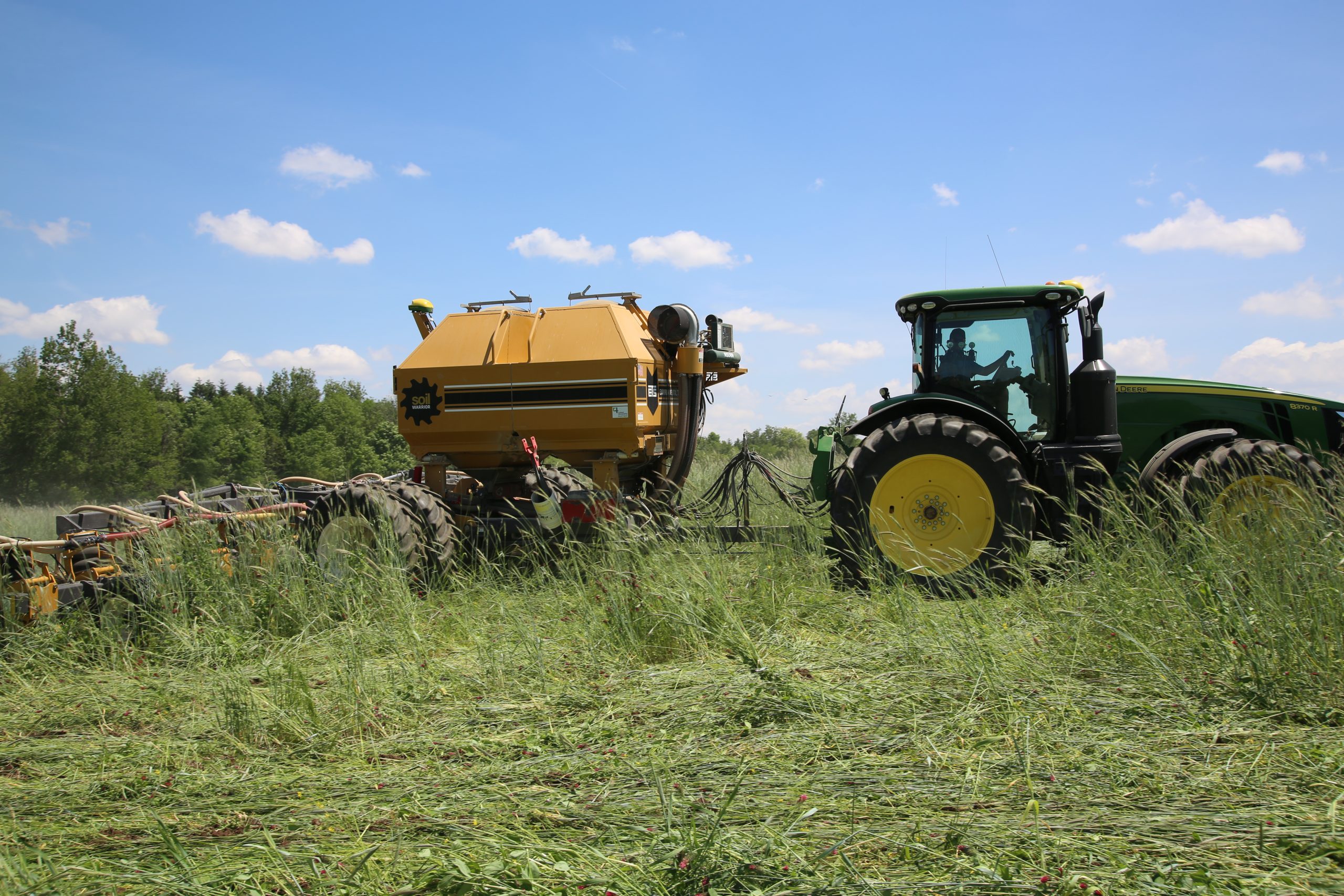
Rick Kootstra planting green at the Huronview site.
Following the 2021 wheat harvest, HSCIA planted an eight- species cover crop, including cereal rye, Austrian winter peas, sunflower, oats, phacelia, turnip, flax, and crimson clover. By June 2, 2022—when HSCIA board member Rick Kootstra planted soybeans—the cover crop had reached a height of six feet.
“There were times I couldn’t see where I was going or what I was doing,” says Kootstra, who ‘planted green’ directly into the standing cover crop. HSCIA will compare the impacts of various termination methods on yield, including roller-crimping and using combinations of Roundup and Sencor and Roundup and Engenia. They also strip-tilled in one field three days before planting. “Planting green can be done successfully but also can be risky,” says Kootstra, who spoke to interested participants at a July pop-tour of the Huronview site. “It can be hard to tell, but we have a good stand [of beans]… we’re a rain away from a really big win,” referencing the dry conditions that plagued southwestern Ontario throughout July.
Planting green has many potential benefits, including providing greater cover crop biomass to increase water infiltration, reduce surface run-off and erosion, and as a natural mulch to prevent weeds.
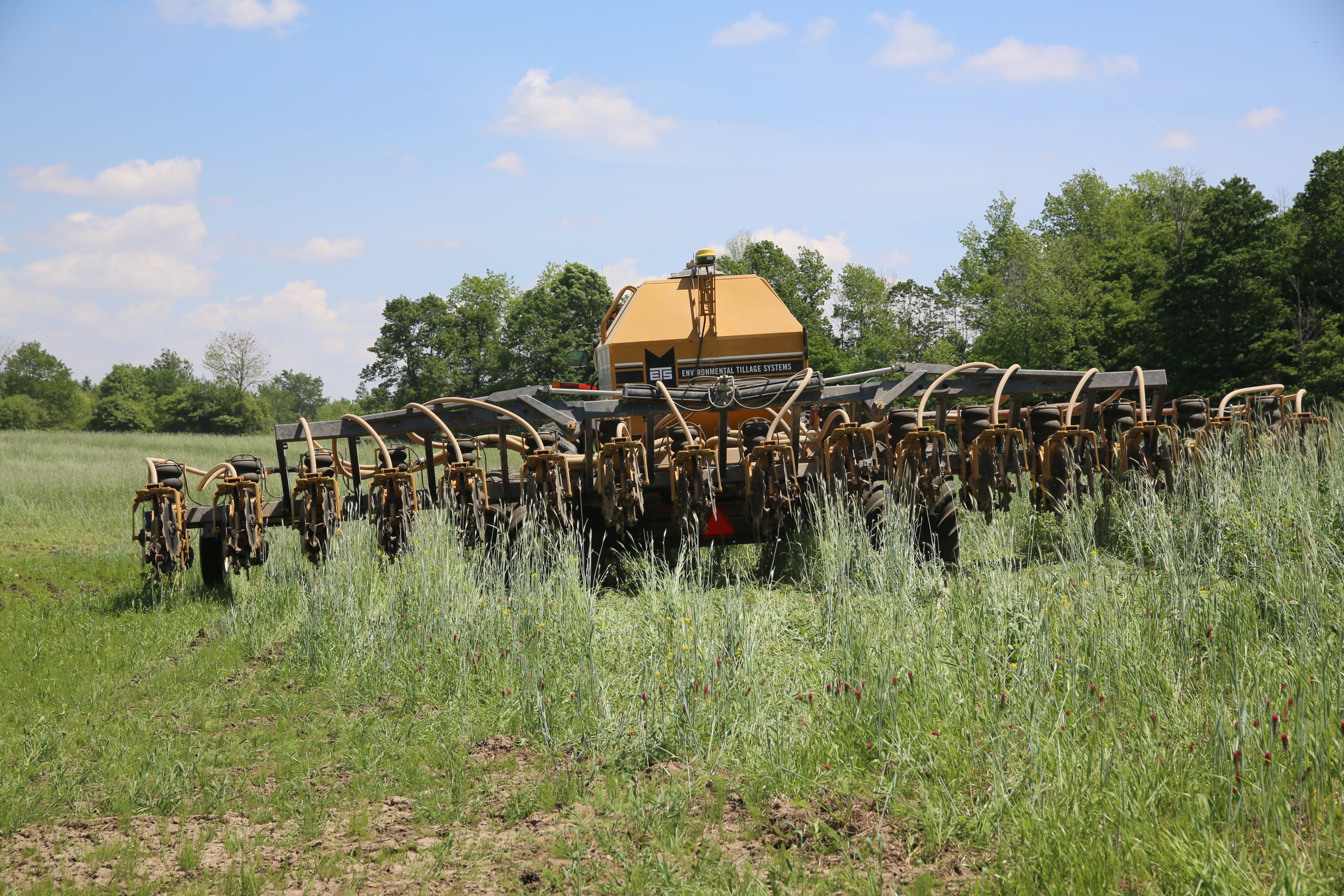
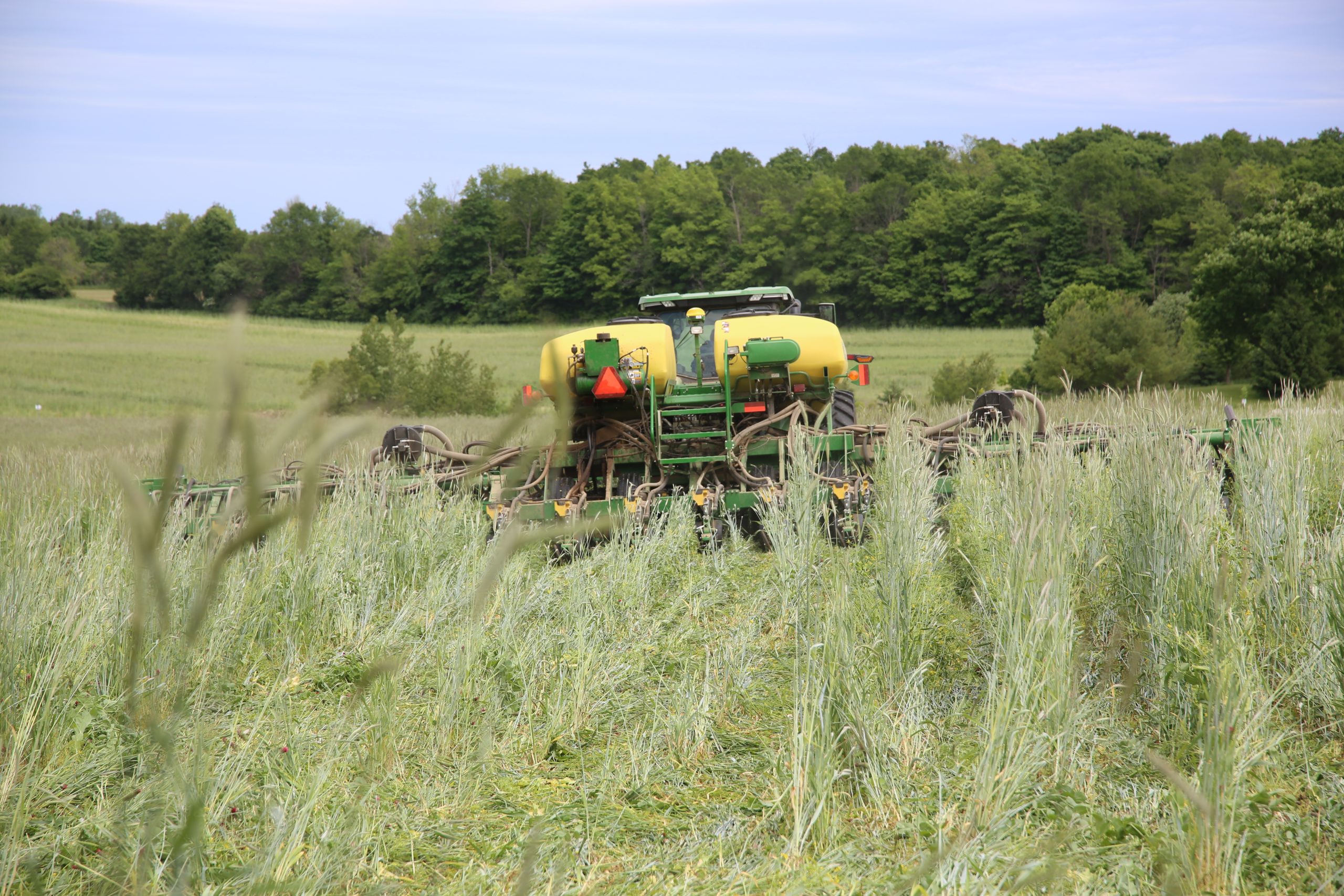
Planting green at the Huronview site.
The planting green trials at Huronview complement the work being done in the Heartland and Eastern Valley SCIA’s Tier 2 research project, “Maximizing cereal rye cover crop management for multiple benefits.” After the project’s third year, Jake Munroe, Soil Fertility Specialist, OMAFRA, says they had seen no negative effect on yield. “The yield impact of planting green versus terminating early is neutral,” he reported at the 2020 OSCIA annual conference.
Kootstra is hoping that will be the case for the Huronview trial plots. “We’re hoping for a really good crop,” he says. “If I did it again, I’d terminate earlier, but I wanted to see what crimping would do.”
More information on the Huronview site and reports on their various projects can be found at: Huronview.net.
Back to Innovator ~~~ Previous article