Taylor Knott is a Director with Grey County SCIA and has worked for eight years as an agronomist at Sprucedale Agromart. She grew up south of Kilsyth in Grey County and was introduced to agriculture by working for neighbours who background steers and sold hay to the horse market in Florida. Taylor credits this experience for sparking her interest in agriculture, prompting her to attend the University of Guelph with the original intent of becoming a large animal veterinarian. Her goal was to find a career that would allow her to get out onto farms and provide support for producers. She is happy to note that an unsuccessful vet school application led to her current position at Sprucedale, where she meets those goals each day. Taylor started as a crop scout for Sprucedale in 2017 and is now a sales agronomist. She works with cash crop and apple producers from Thornbury to Port Elgin, and lives with her husband on their farm near Ravenna.
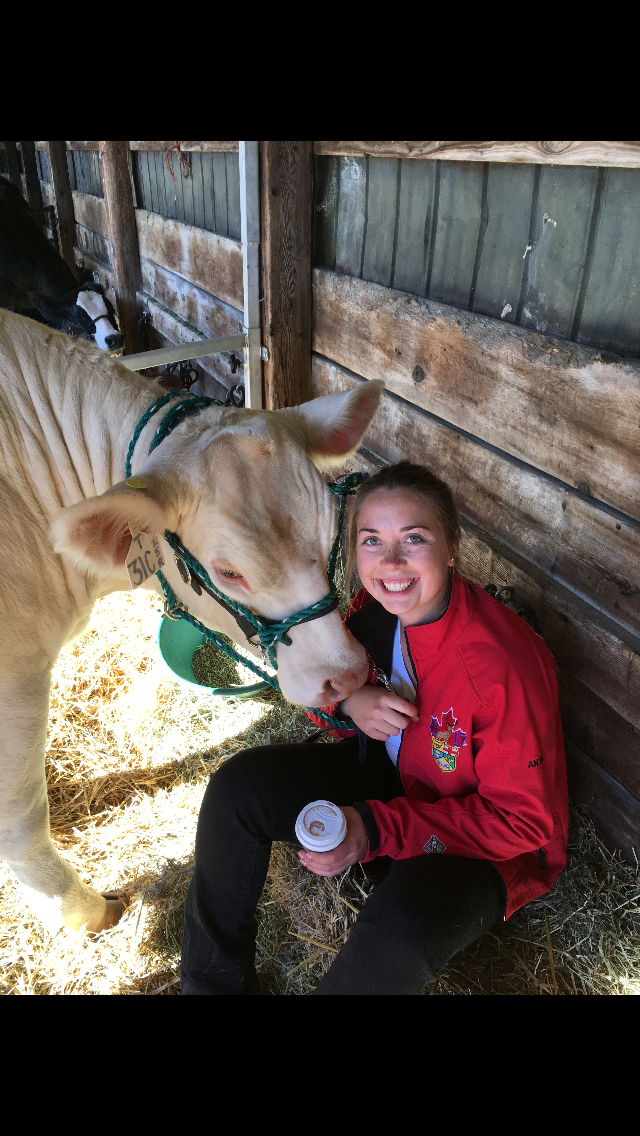
Taylor Knott, Grey SCIA member.
Taylor talked about her activities at Sprucedale throughout the year, starting with the support they provide for producers during busy spring planting. She commented that at that time of year it is “all hands on deck” to deliver fertilizer and chemicals, take water to sprayers and keep everyone going for the roughly six-week period.
Summers transition into a focus on crop scouting, and harvest follows with the opportunity to really put everything that happened throughout the year together. In October and November they begin to make plans for the following year, considering the seed and fertilizer that will be used for the following season.
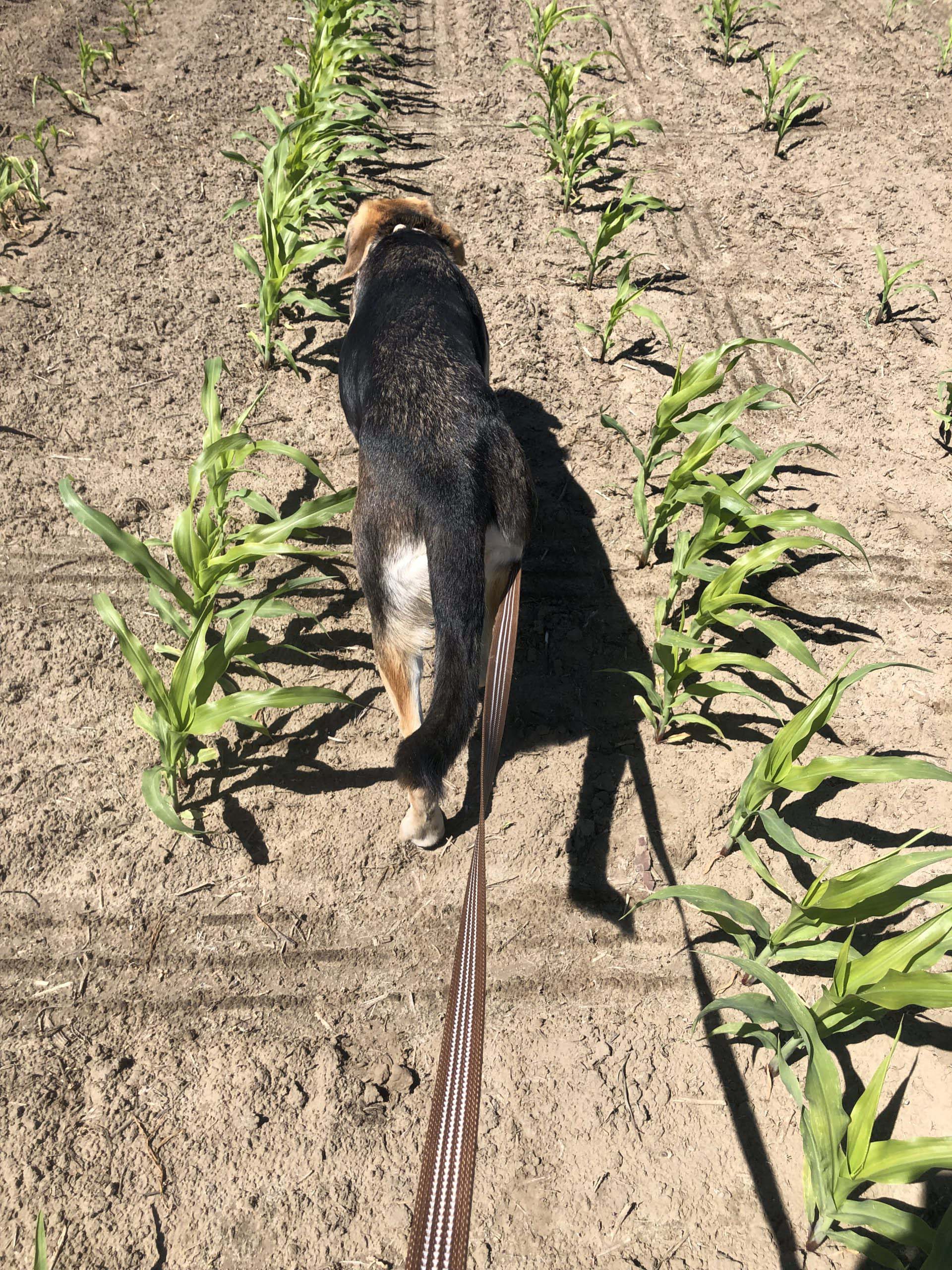
Scouting corn.
Taylor shared that creating fertilizer plans is a highlight of her work. She described them as an opportunity to take into account all the different facets of each customer’s operation and tailor the plans to suit them best. There is a lot of reflection on the previous year’s success or failures to make sure that she can serve each of her customers the best for the coming year.
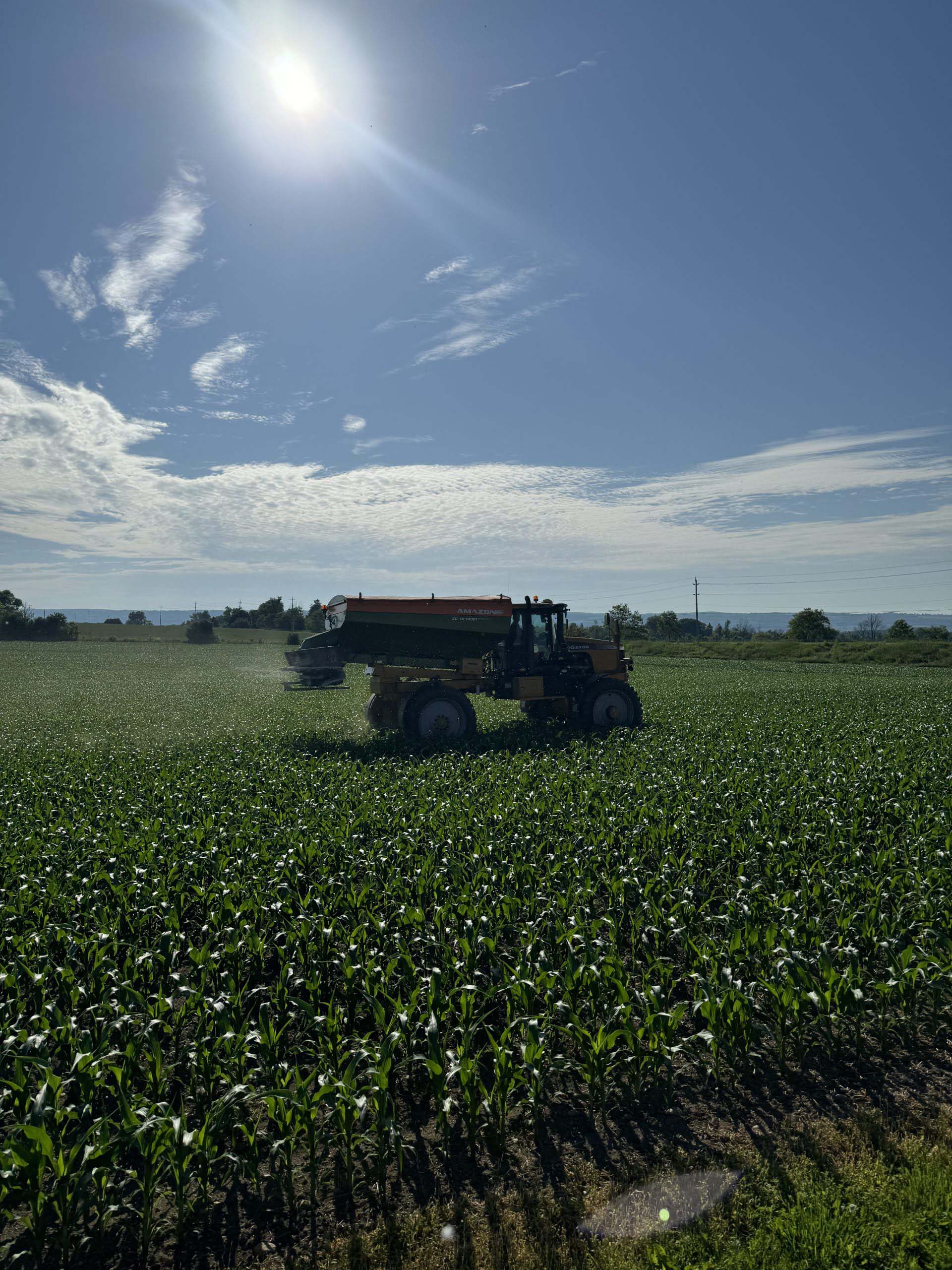
An Amazone fertilizer spreader topdressing corn.
From this type of fall and early winter planning they move into doing seed deliveries for the following spring and the cycle starts again!
Taylor talked about some of the changes that she’s seen in the eight years she’s been with Sprucedale. One thing she noted is the dramatic increase in yields, sharing that when she started out, 40 bushel soybeans were considered good, but now producers are pushing for 60-65 bushels per acre. The same goes for corn, which has jumped from the 170 ballpark to 200 bushels or more. She attributes these major increases to improved genetic varieties and higher management intensity, noting that producers are taking more trips over their fields to apply nutrients when and where the plant needs them. Taylor pointed out the increase in split applications of nitrogen and in the use of nitrogen loss inhibitors which are jointly saving producers dollars and preventing harmful loss of nutrients to the environment. She noted an increased focus on what is put down in fields with more attention directed to applying products at the right time and place, with the right field practices.
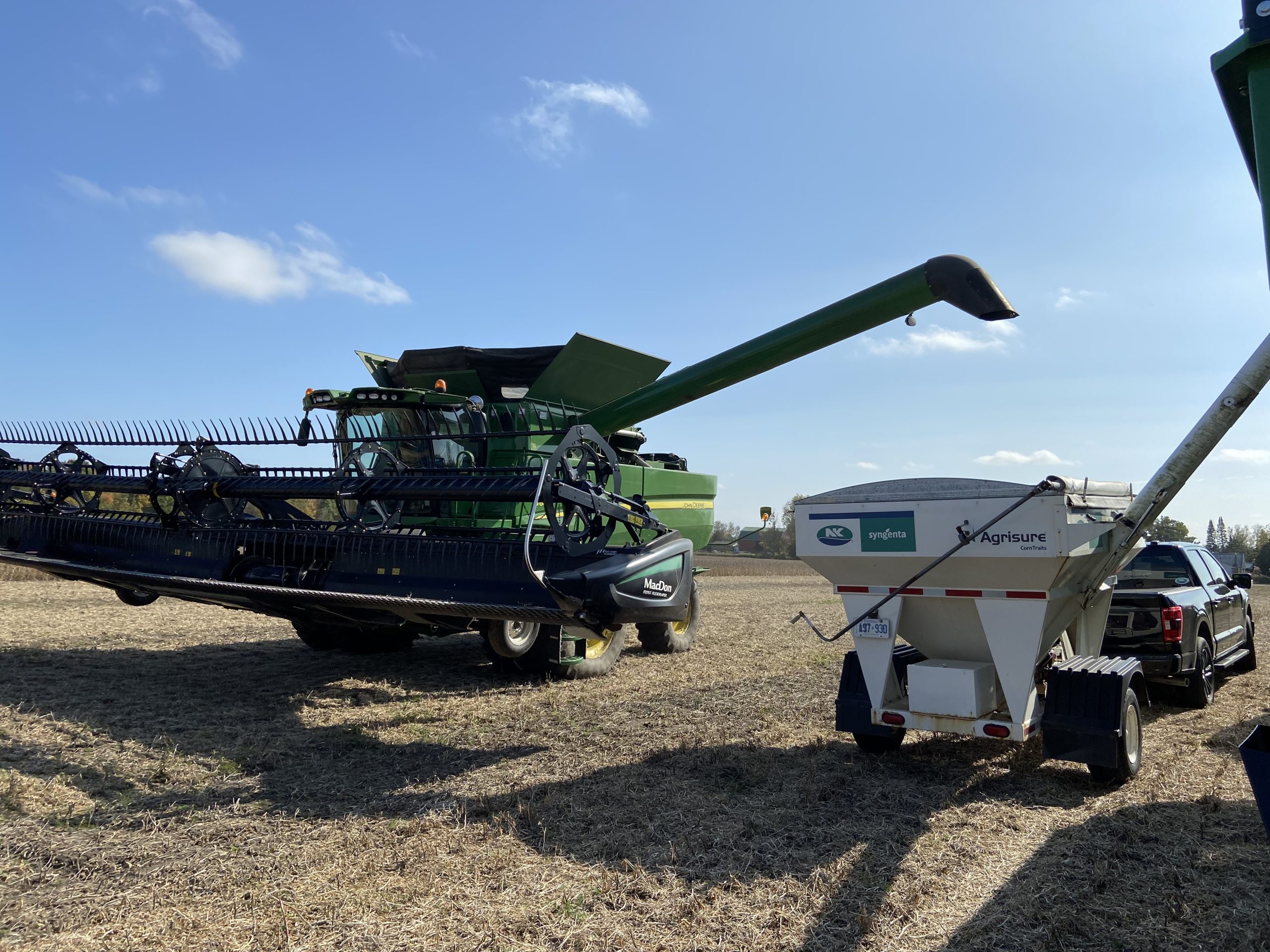
A soybean plot coming off.
She’s seen a large increase in the use of cover crops after wheat, the scenario which gives the most establishment time and the highest rate of return on investment. The benefits usually noted include reduced soil erosion and the ability to maintain organic matter, if not build it. She feels that the On-Farm Climate Action Fund (OFCAF) program has been successful in offsetting the cost of the more diverse cover crop mixes, making them attainable for producers to experiment with. That’s been a great thing to come from the program.
When the topic moved on to tillage, Taylor explained that the big movement to no-till or minimum-till was before her time. She thinks that attitudes now trend more towards using no-till where no-till suits. Situations like wheat after beans and sometimes beans into corn stubble are rotations with an opportunity for less tillage to be incorporated. Where a field might once have been worked three times to achieve a lovely soft seed bed that was vulnerable to erosion, it now might get worked once or twice. Producers are prioritizing planting success and making fewer passes.
Taylor is excited for advancements in crop technology – listing new products like Bayer’s Vyconic soybeans and new short corn varieties that are being used in the U.S. corn belt. She said that there are big advancements in chemistry, necessary as government and consumer pressure restrict the products that can be used in-field. Her feeling is that “change will only change faster” as better technology will increase the speed that research can bring new products to market. She also mentioned that these technologies are really needed as farming gets harder – the environment is more unpredictable and therefore harder to work in, and restrictions placed on agriculture are harder to work under.
Taylor spoke briefly about working with apple producers, noting what an extremely challenging industry it is. Like other commodities, costs and input prices can rise, but the revenue paid by grocery stores and packing plants doesn’t necessarily increase. Excellent crops are subject to storage conditions which are out of the producer’s control and sales don’t happen until after the crop comes out of storage up to a year later. Apple production is a highly scrutinized commodity for chemical usage on the trees and they’ve had some reliable and cost effective products taken away recently which has increased cost of production even further. Taylor also commented on the diversity of management practices between each apple operation, and the level of expertise held by producers. She said the combination of the two actually make apple orchards more difficult to provide service for – the producers have such depth of knowledge and each operation is unique, so what is successful in one orchard doesn’t always work for the next.
Soil sampling was another area that Taylor has seen changes in. Producers used to take composite samples from 25-acre or larger sections of the field. More and more, intensive practices are being adopted – two and a half acre grid sampling and SWAT maps are now commonly being used. These practices demonstrate the adoption of precision ag – an area which captures Taylor’s interests. She works on variable rate precision fertilizer maps, hoping to increase fertility in areas which tested the lowest but still have potential for increased production from the year before. She also stressed that it’s important to pay attention to chronically poor producing field areas which are unlikely to be able to improve and not dump fertilizer on them, effectively throwing money away.
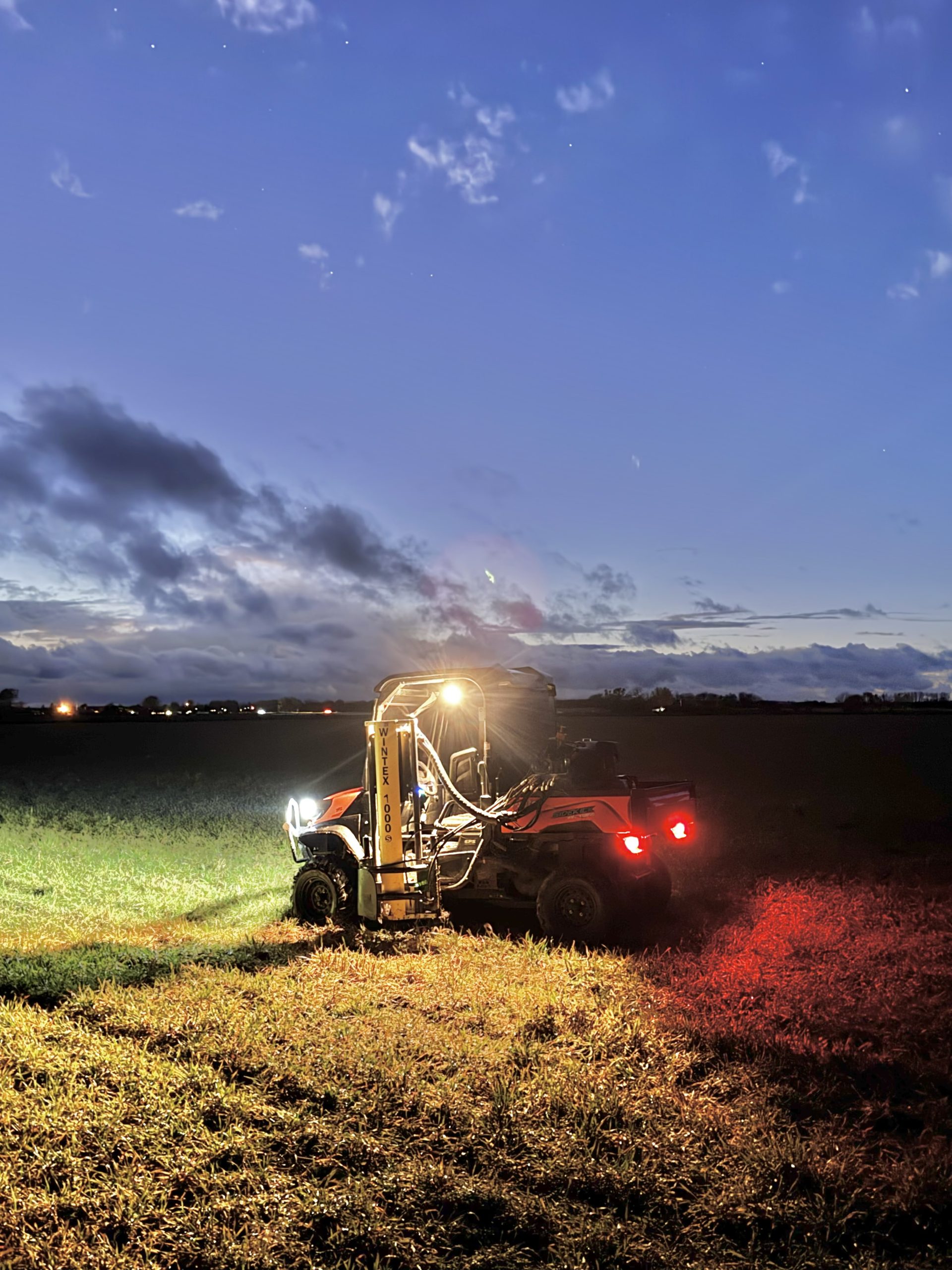
Wintex hydraulic probe used for soil sampling.
Building fertility or variable rate planting maps and correlating them with harvest maps is something that gives Taylor a lot of satisfaction. She enjoys being able to create management plans for the following year using data collected and working to see improvement for the producer. When putting these plans into effect, Taylor shared that some of their customers help to generate the maps with their own equipment and some are done with Sprucedale’s equipment.
Taylor talked about technology that they use and some that she looks forward to in the future. Something she’s excited for is an airflow which has separate dual bins and can variable rate two different fertilizer maps at the same time. Other advancements that Sprucedale has already made include a Pulse-Width Modulation (PWM) system for their sprayer, giving them better control over spray application. They also have an automated metering system for their truck which loads the sprayer. It metres out chemical without human intervention, increasing efficiency and accuracy and decreasing user exposure.
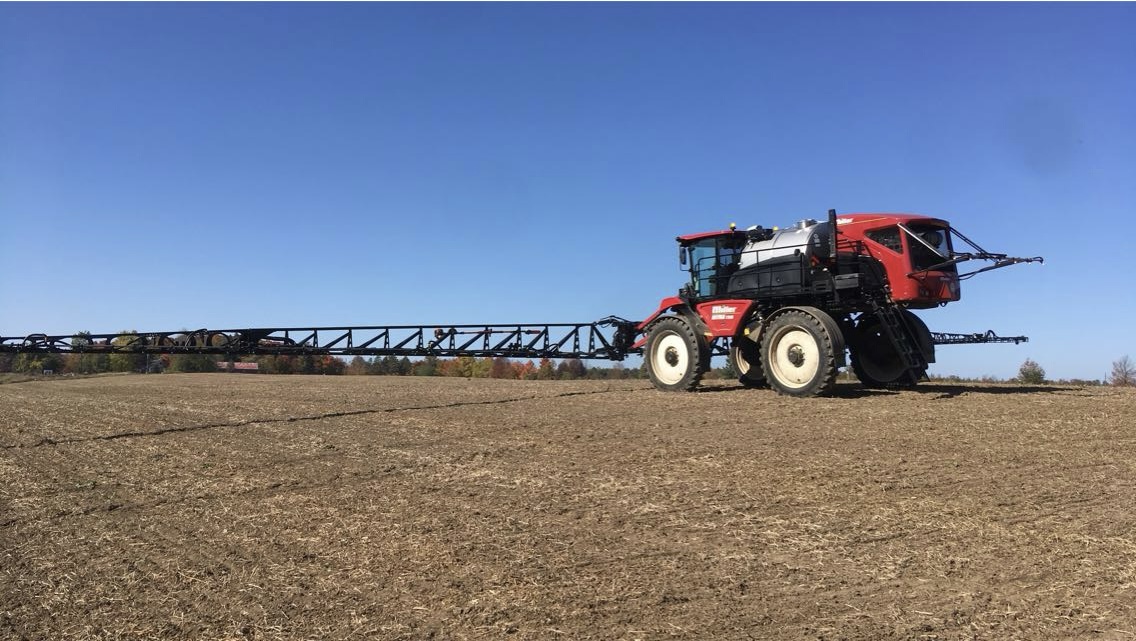
The Millar sprayer with the PWM system that maintains consistent droplet size even as the sprayer’s speed changes.
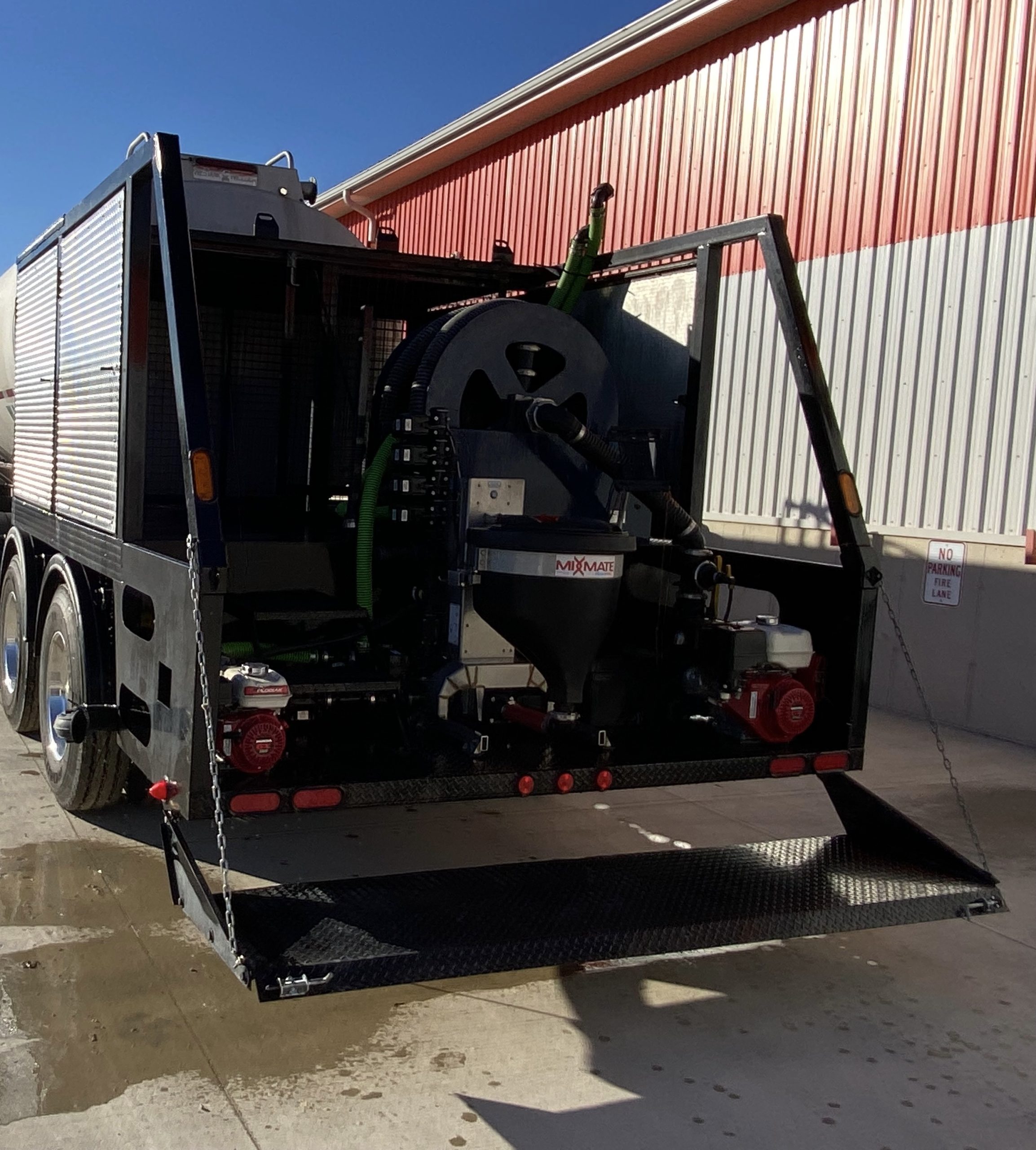
The MixMate water truck that the sprayers load from.
Altogether, advancements in technology add up to mean fewer mistakes amongst many moving parts and pair up well with advancements that customers have made on their farms.
Narrow profit margins and global uncertainty are two issues that Taylor feels are major challenges for today’s ag industry. Input prices staying high while commodity prices drop is causing stress on operations. Trade disputes with the U.S. alongside Chinese tariffs on canola are hitting hard. She feels that using all tools available to leverage efficiencies will be important for businesses to stay profitable. Producers need to plant with as much accuracy as possible, following that up with accurate, efficient fertilizer and chemical applications and a careful harvest so that every kernel of grain can make it to the elevator.
What is a major opportunity for the ag industry? Taylor says communication and the ability to share knowledge! She feels that the more we know, the more opportunity we have to make use of new technology and increase yields. YouTube has become a major information source for many producers, and organizations like Ontario Soil & Crop offer perfect opportunities for networking.
From a community standpoint, Taylor is involved as a director for the Grey County Soil & Crop Improvement Association and a committee member for the Town of the Blue Mountains Ag Advisory committee. She mentioned that everyone is busy and it’s easy to feel like there’s no time for volunteering. On the other hand though, these organizations need people to step up and give their time in order to exist, and there are benefits to giving it. Taylor noted that it’s nice to be involved in groups connected to your industry as they keep you up-to-date on what’s “on the horizon”. With a nod to the Grey Soil & Crop crew, she commented that it’s refreshing to see such a great group of people who are so engaged and committed. On the Ag Advisory committee she’s also felt the importance of advocating for agriculture. It’s an industry that is continually prioritized to a lesser extent, so keeping voices out there talking about it is important. She also feels that the sense of community that is formed through volunteer groups and like-minded people is motivational and it’s satisfying to think that a person might leave their mark on things as they go.
I’d like to thank Taylor for taking time out of a very busy schedule to share her thoughts for this article! We’re very lucky to have so many engaged, forward-thinking members in our organization and it’s a pleasure to be able to gain insight from them with each edition of the Bulletin.
Emily McKague