By: Emily McKague, Georgian Central Regional Communication Coordinator
Dr. Lee Briese was the guest speaker for Georgian Region’s July 27th Soil Health Open Discussion night. The virtual meeting was open to anyone across Ontario, with a recording available for those unable to tune in live.
Lee Briese is a Doctor of Plant Health, agronomist and soil scientist who works for Centrol Ag consulting in North Dakota, USA. He scouts approximately 83,000 acres of cropland and assists farmers improve crop health, production and their bottom line with philosophy based around the following five soil health principles:
- Soil Armour
- Minimize Soil Disturbance
- Diversity
- Continuous Living Roots in the Soil
- Livestock Integration
Dr. Briese talked about the challenges of balancing the bottom line of a business with practices that will improve soil health and noted that while all the above are important measures, there are situations where they do and don’t apply. He said that, “’don’t ever touch the soil,’ is not a good rule if your crops are struggling” and his principles are a basis for guiding decision making, not hard and fast rules.
The Q&A kicked off with a producer who asked about managing corn residue. Dr. Briese advises farmers in his area to cut higher and run less residue through the combine, saying “if it’s still attached to the soil, then you don’t worry about spreading evenly.” He also noted that stubble dries better standing and is then easier to cut through the following spring. Another option would be to experiment with vertical tillage, as being able to size the residue and even it out might help.
Conversation turned to selecting cover crops, with Dr. Briese advising not to plant a weed or a host for significant pests. Don’t mix cereal rye and wheat as there are no control options for getting rid of the rye once wheat is established. Stay away from brassica species in a field to be growing canola, as they share club root. Be mindful of keeping white mold hosts (he noted sunflowers as an example) at least two years apart from soybeans. If the first species that comes to mind doesn’t work, Dr. Briese said to look for another plant within the same group (warm or cool season grasses, warm or cool season broadleaves, or legumes) as a substitute.
A participant asked for advice on fixing compaction after it had happened. Dr. Briese joked that they “hit [him] right in the can’t fix it face” but continued with some suggestions. Know what the moisture content is in the soil and pay attention to your timing when you go back in to loosen things up; wait until the soil is dry. Compaction below 4” deep is especially hard to manage as tillage equipment that can reach it is heavy and tends to just push the compaction problem even lower. Cover crops with aggressive root systems can help, he noted that brassicas and oats have good rooting, will control soil moisture and also give equipment something to drive on.
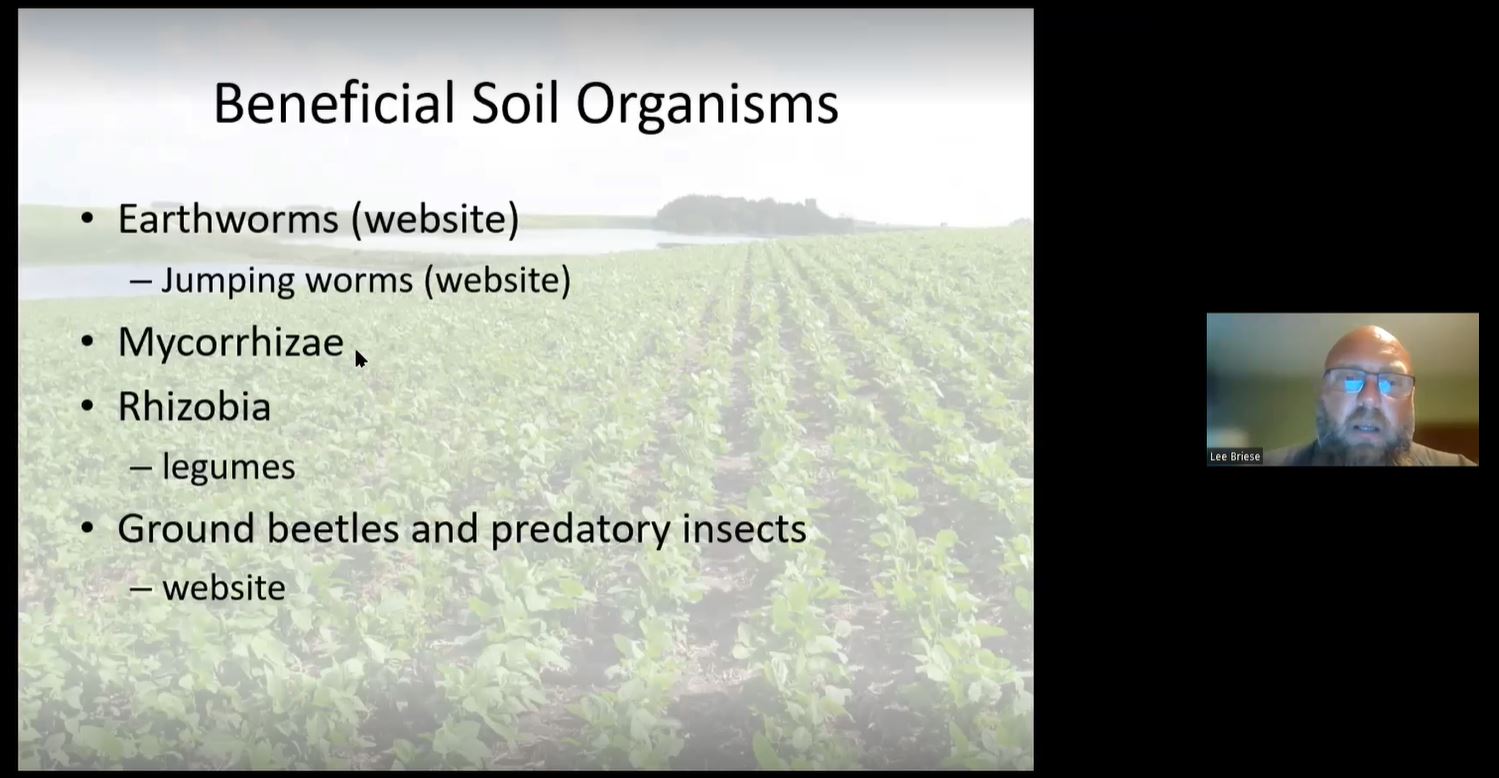
Dr. Briese spoke about beneficial insects which can help control pests when their populations are allowed in fields. Syrphid flies and Ladybugs were two examples of species that can be very effective if allowed to control pest problems. He noted that beneficials aren’t often scouted for, but tracking their populations could allow producers to recognize instances where spray applications could be skipped, saving the producer money and keeping the beneficials alive.
Other topics brought up included the impact of fungicides on soil fungi (likely low), whether compost teas could act as a fungicide (likely limited efficacy), nutrients that are released and available from cover crops (this is tough to measure), manipulating carbon to nitrogen ratios with cover crops (not a short term fix), and managing straw stubble prior to corn (similar to managing corn stubble). Suffice it to say, Dr. Briese was a hard speaker to stump with a question!
If you missed the event but would like to see the recording, you can check it out on the Grey Ag YouTube channel: https://www.youtube.com/watch?v=EnpzDDFUmKY