Micha, together with his wife Tina and 2 small boys, farm just outside of Fort Frances, in Northwestern Ontario. They run a small beef herd of 50 head, and in the last few years have diversified into some cash cropping. The Gerber operation was highlighted during a panel discussion as part of the Northern Ontario Ag Conference’s Sustainability in Cropping Systems session.
The Gerbers started his farm with a small herd of 18 beef heifers in 2014. The land they had was mainly bush, and so beef was the best way to make use of this. Soil health was not yet at the top of his mind, as he was beginning his farming operation. Over time, he started learning more about different regenerative practices and a lot of the ideas made sense.
Micha realized they could improve their production by better managing the land they had, and so they implemented rotational grazing. They could use rotational grazing as a management strategy to increase capacity at a time when buying more land was not an option for them. From there, they were able to expand their herd.
The more they improved the land, the more they considered crop production to diversify the farm operation. The beef market can be quite volatile, making it difficult for a producer just starting out in the industry. The return on investment can be quite low in beef farming, which can be challenging if you are trying to expand. Cash cropping provided the return on investment needed to support the beef herd expansion. Adding cropping to the operation was a challenge due to Micha’s limited cropping experience. However, Micha has been able to work with other local farmers, starting with custom planting and harvesting while they slowly build up their own fleet of equipment to crop more on their own.
Speaking of farm diversification, the Gerbers also have an egg grading station under the family brand of Gerber Farms. They also have plans to diversify and develop their own egg production facility, though this remains in the design stage. Currently, most eggs sold at the family station come across the border already graded from Manitoba, and they would like to replace some with their own production eventually. By diversifying, farming for the Gerbers has been financially viable.
Micha is constantly exploring new ideas to help improve soil health. However, weather has certainly created challenges. A drought in 2021 was followed by a very wet year in 2022. In the drought of 2021, he tried some wide rows of 60 inches for twin-row corn inter-seeded with white clover, with the goal of providing more nitrogen to the corn. This was the first year they grew corn. Due to the drought, it took almost a month to germinate post-broadcast. It grew a bit but not to its potential. This drought prompted them to try a whole bunch of things, including having a back up plan for corn grazing in 2022. Their hay crop was abundant in 2022, so they ended up harvesting most of the corn for grain instead of grazing it. He was able to keep the cattle off hay feed much later into the winter, until February. They saw good gains on the corn-grazed cattle. Now the corn grazing is finished, and they are into calving season, the herd is back on hay.
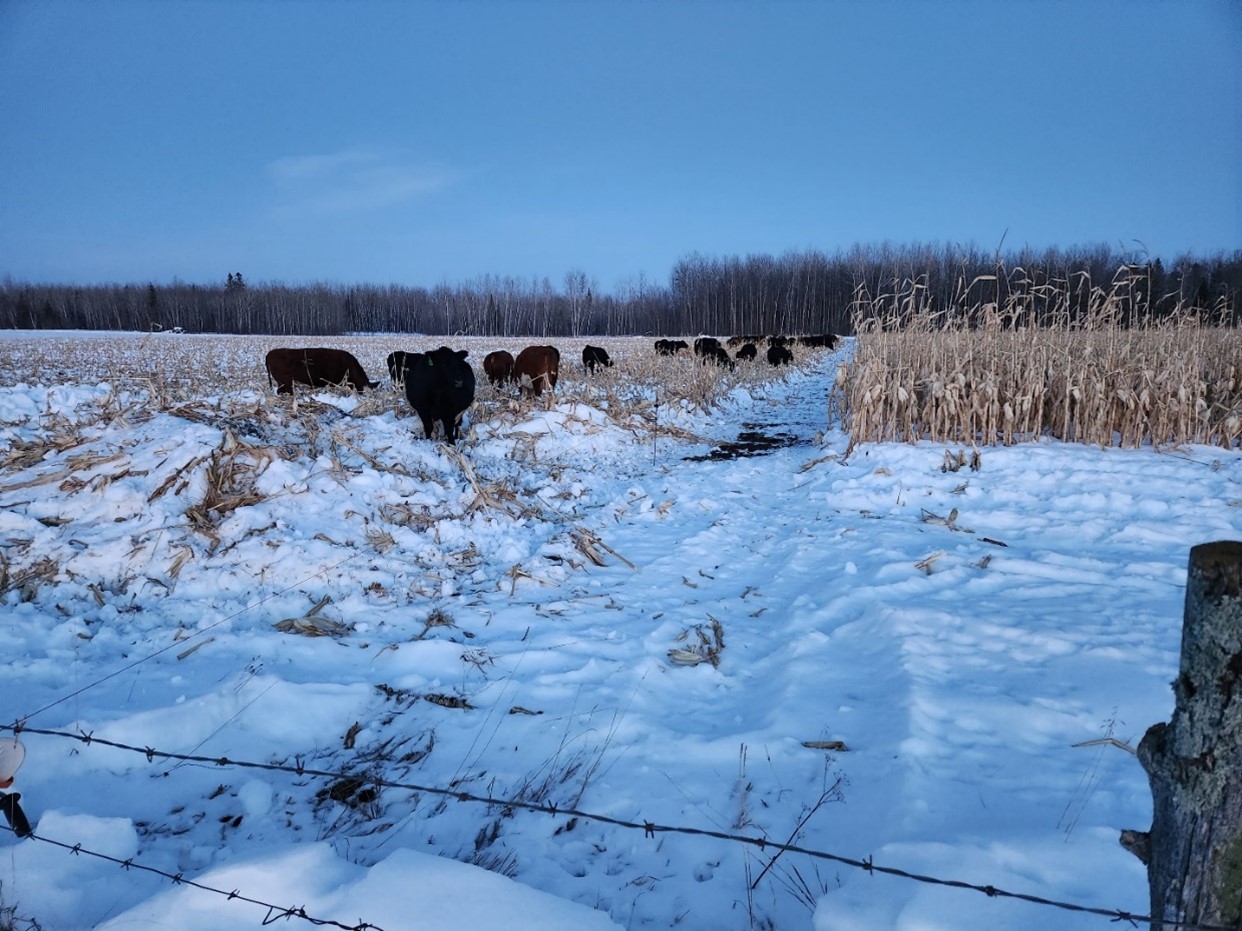
(image: Cattle Grazing corn at Gerbers)
In 2022, they tried to intercrop into standing corn, but it was so wet that they could not complete the job. The few passes that they did try did have good cover crop growth. They were able to graze this field as well. This corn was going to be harvested for grain, but as the field was not tiled, it did not produce a good grain crop.
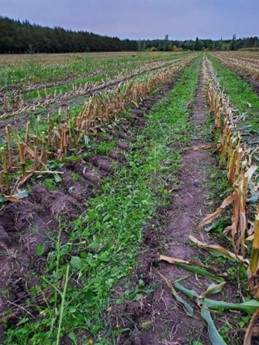
(Image: cover crop seeded into standing corn)
As for his crops, Micha’s average grain corn production was 110 bu/ac in 2022, which the best field netting 170 bu/ac. He has so far marketed corn and soybeans from his own operation. He has not had great success with the soybeans so far, but other farmers in the area are hitting 45 bushels per acre, so he hopes to improve. He has also worked in partnership with other farmers to grow barley and wheat.
Micha is constantly learning. He is inspired by authors and educators like Jason Mauck’s work on relay intercropping, and Gabe Brown’s book on regenerative agriculture. Through attending various seminars and workshops, Micha began to explore cover cropping and livestock integration. Micha has learned about extended grazing and forage systems from attending talks by Graeme Finn from Union Forage. Micha attended the Innovative Farmers Association of Ontario conference in 2022, which provided him with many ideas for intercropping and keeping livestock on cropped land. He was also able to connect with other farmers who could provide him with advice.
In 2023, Micha plans to continue to do what he knows works well. He had good success with corn grazing, and will continue. He wants to try integrating cover crops in soybeans, although this can be challenging with the climate. Another important goal for 2023 is to fertilize according to soil samples to optimize yields and production. Fertilizer prices in 2022 were punishing, and so he had to cut way back on the amounts applied. This year’s outlook is better, so he wants to apply according to recommendations. They have adequate input suppliers for fertilizers, with 2 or 3 options in the area. The cost to bring inputs in and crop out is high due to their geographic isolation, but the services and community are supportive.
He will continue to learn as he goes. He would have loved to attend post-secondary to study agriculture, but did not, and as it is, he will continue his farm journey listening and learning from others, and picking up things as he goes. He feels that half of farming is just learning from others rather than adding your own twist to it. As they clear more land, he hopes to be able to figure out an ideal rotation involving cash crops, cover crops and cattle grazing.