Soil Health fact sheet provided by Soils at Guelph.
SEEING THE RESULT$
Gerrit Herrema, a third-generation farmer near Uxbridge, Ontario is clear when it comes to the economics of reducing tillage. After 30 or more years of reduced tillage practices on their farm, he can say “it’s gotten so that we’ve only got to do one pass over some of the fields. That means we’ve saved costs in fuel, equipment upkeep, and time.”

What could that mean in dollars and cents? A report by the Greenbelt Foundation figured that the savings mentioned by Herrema could amount to an average of $36/ac for corn and $27/ac for soybeans (based on average operating costs from across Ontario). The report added that additional costs might come from a greater herbicide requirement for weed control and yield losses in the short term.
A WHOLE SYSTEM APPROACH
Reduced tillage is more than just changing-up tillage equipment; it is about minimizing soil disturbance to allow communities of helper microbes, including fungi mycorrhizae, to be put to work in improving the soil’s structure. Research shows that good soil structure improves crop growth. It also reduces erosion.
“Reducing tillage on our sandy loam/sandy soils reduces wind and water erosion. When our soil blows or washes away, we’re seeing our money wash away, too.” (Herrema)
Research is clear that reduced soil disturbance also leads to improved soil structure and drainage. This is true in both finer textured and coarser soils. In the heat of summer, the increased water-holding capacity of the better structured soils can lead to more drought resistant crops.
Tillage decisions can be helped along by considering how your farm management systems – like the crops in your rotation – can be adjusted to support your reduced tillage goals. “We’ve found that incorporating a cereal cover crop after wheat with a fall termination makes the transition to a no-till corn planting a lot easier”, says Herrema.
TILLAGE INTENSITY OPTIONS:
Some field conditions, field crop rotations or business constraints can make some reduced tillage options more viable than others. Luckily there are options.
Rotational tillage: This involves planting no-till corn or wheat into soybean ground, but then a bit more tillage to break-up corn stalks and straw.
Targeted tillage: Sometimes a wet harvest ruts up the headlands or some smaller areas of the field. Don’t rip up the entire field to fix a problem that is confined to small areas.
Strip tillage: Only a narrow strip for the seedbed is prepared. This is growing in popularity in Ontario.
No-tillage: The field is left mostly undisturbed, except for seeding, nutrient injection, and residue management at harvest.
PRO-TIPS:
Start small: Try reducing tillage in one part of your farm. Fields closest to home can be observed more closely. Hire a custom operator to try it out for a few years.
Manage residue: There are many ways of doing this. Many ways start with the combine.
Access funding: Making the switch to reduced till can mean investing in new tillage and planting equipment, or new technology (RTK can make planting in heavy residue possible). There are programs across the province to help off-set those up-front costs. This is one of society’s ways of supporting you
Find your people: Other farmers, crop advisors, Soil and Crop Associations, field specialists or equipment dealers may have lived experience with reduced tillage. They are a great resource for learning what worked, what didn’t, and what they are trying next.
PATIENCE PAYS
The report by the Greenbelt Foundation determined that when profitability is measured over a period of 5 years rather than any one single year, the economic benefits of reduced tillage are more fully realized (Table 1). This allows for the different ways that individual crops respond to reduced tillage to average out through the rotations.
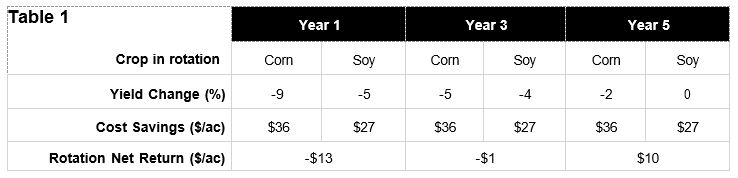
Research has also shown that the economic response of reduced tillage will vary depending on soil texture – with initial yield penalty in finer textured soils lessening as soil microbes are put to work to improve soil porosity and drainage. In other words, it pays to be patient. And those with finer textured soils need to be more patient than others.
WHAT’S THE BOTTOM LINE?
What would a reduced-tillage system look like on your farm? How would you weigh the cost-savings and soil health systems benefits against your status-quo? In any case, always keep good records, as it aids in tracking the impact of every decision.
Up-side of reduced tillage:
- Savings in fuel costs
- Savings in equipment upkeep
- Reduced labour
- Improved net returns over time
- Reduced losses from soil erosion
- Improved root and crop growth
- Improved drought tolerance
Fine-print considerations:
- Additional herbicide requirements?
- Resources to wait-out net return period?
- Considerations of soil texture impact on net return period?
- Capacity to manage something ‘new’ in a particular year?
Additional resources:
Towards a Business Case for Soil Health: A Synthesis of Current Knowledge on the Economics of Soil Health Practices in Ontario. The Greenbelt Foundation. https://www.greenbelt.ca/business_case_soil_health
For all OMAFRA’s Best Management Practices Resources, including Strip-Tillage, No-Tillage, Residue Management, Wind Erosion, Soil Erosion by Water, Tillage Erosion, go to: bmpbooks.com
Possible funding programs to support equipment modifications, purchase, new practices, etc., consult:
- Your local Conversation Authority
- OMAFRA Programs
- Ontario Soil and Crop Improvement Association

This factsheet is a summary of key findings from the report, Towards a Business Case for Soil Health. Soil health practices considered in the report and this Factsheet Series are: reduced tillage, cover crops, crop rotation, manure amendments, rotational grazing and various 4R nutrient practices. The report estimated that Ontario farm net returns would increase by approximately $14.6 million dollars per year if an additional 10% of the agricultural land in Ontario were to be managed to support soil health.
The numbers come from peer-reviewed, Ontario-based research and the analysis is based on financially-representative, farm-level budgeting techniques for Southern Ontario. Estimates are conservative and do not represent profits possible with experienced management.