LTVCA Summer Events
Save the date for the LTVCA 2022 Cultivating Conservation Tour – Thursday, September 8th. Come out with the family to learn about regional environmental research and conservation initiatives. Attendees will have the opportunity to visit and see examples of landowner tree, wetland, and native grassland restoration sites. The tour will end at the Red Barn Brewing Company, for a social gathering that will include a guest speaker! The LTVCA will provide more details about event registration at a later date. We hope you can join us!
LTVCA 2022 Soil Health Program & Stewardship Project Highlights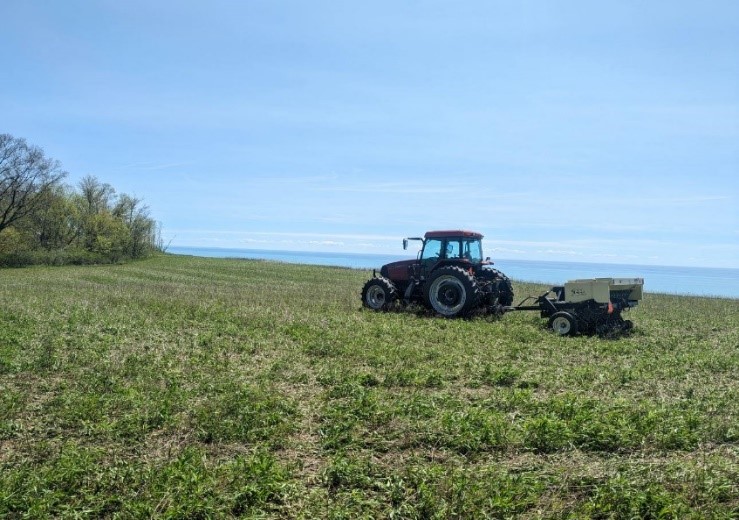
The LTVCA launched the 2022 Soil Health Program on April 13th. The objective of the program is to provide financial support to farmers who are planting cover crops to sequester carbon, improve soil health, and to reduce agriculturally sourced phosphorus loads. The program offered farmers $15.00/acre to plant cover crops in the LTVCA watershed.
As of June 3rd, the $140,000.00/year budget has been fully allotted to project applicants to offset the cost of cover crop plantings during 2022 and 2023. In total 72 farm businesses were approved for funding contributions that could support the planting of 9,300 acres of cover crops. The LTVCA will still accept applications for projects, that will be placed on a waiting list for review in the scenario that additional funds become available during 2022.
As the sun goes down on tree planting season, we have just a few road side plantings to complete! 72,000 trees and 64 acres of native tall grass prairie was planted during the Spring of 2022 in the LTVCA watershed. Thank you to all of the landowners that continue to take action to improve the health of the lower Thames watershed! Contact the LTVCA to start planning your project today!
ERCA: Essex County Demonstration Farm
The Essex Region Conservation Authority (ERCA) and partners from the agricultural community established the Essex County Demonstration Farm (ECDF) at Holiday Beach Conservation Area in 1996. Since then the project has received considerable support and interest from the agricultural community. The goal of the farm has been to demonstrate best management practices and innovative technologies that will conserve soil, maintain productivity, improve water quality and quantity, and illustrate that farming and the environment can coexist.
Spring work continues at the Demonstration Farm with most fields now planted and weed control continuing on both corn and soybean fields. This year we are trialing nitrogen biological enhancement treatment on both corn and soybeans and plan to monitor differences in yield with control plots. The biological enhancement uses nitrogen fixing microbes applied to plants with the ultimate goal of reducing the amount of nitrogen added as fertilizer to maintain adequate yield. The application of nitrogen fertilizer contributes to greenhouse gas emission through the loss of nitrogen oxide to the atmosphere. The successful use of the biological enhancement could be an important tool to help mitigate climate change. Soybean varietal trials continue at the Demonstration Farm, as cover crop demonstrations and full crop rotation that includes alfalfa. There is also an ongoing water quality monitoring project to examine the loss of nutrients from surface and tile flow under different tillage conditions over multiple years of crop rotation.
After a slow start due to wet weather, more than 85,000 trees were planted and distributed across the Essex Region watersheds. A new wetland was created near Holiday Beach Conservation Area, and a significant habitat restoration project was undertaken in the Detroit River watershed at the Collavino wetland.
ERCA is offering grant incentives for the establishment of cover crops, as well as soil erosion control projects. Visit the https://essexregionconservation.ca/stewardships-grants/landowner-grants/ or call 519-776-5209 ext. 369 for more information or to apply for a grant.
St. Clair Region Conservation Authority (SCRCA) Update
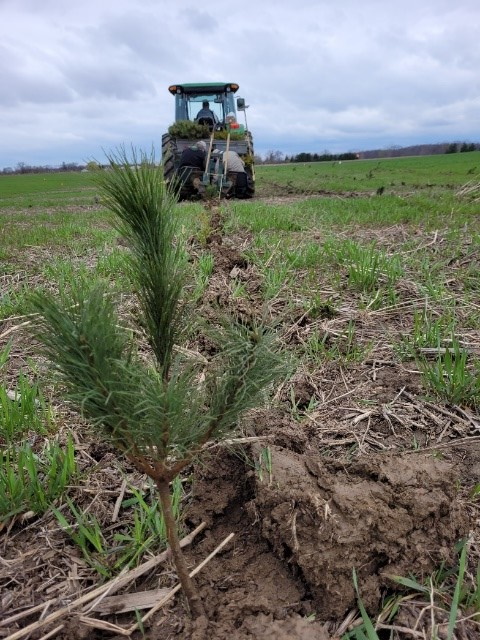
Figure 1: SCRCA staff planting pine seedlings in retired field during 2022 planting season.
This year has been as busy as ever for the SCRCA tree planting crew! Over 46,000 trees were planted on 58 acres across the St. Clair Watershed. These trees were planted as windbreaks, riparian buffers, and block plantings.
We’ve also been seeing a growing interest among farmers in our region with respect to agricultural green infrastructure and implementing wetland habitats. Green infrastructure, such as grassed waterways or in-field erosion control berms, can slow overland runoff and keep nutrients and soil where they are most needed – on the field to grow crops. Wetlands help protect and filter water, improving its quality and play a key role in helping to store and regulate water levels both in terms of flooding and low flow. Wetlands are nature’s kidneys – cleaning water by filtering pollutants and absorbing nutrients!
If you are interested in planting trees, creating a wetland, or implementing a Green Infrastructure project like a grassed waterway or an erosion control structure in the St. Clair Region Watershed, please contact Emily Febrey efebrey@scrca.on.ca or 519-245-3710 ext. 241. The SCRCA continually sources funding to offset the costs of these projects to minimize the costs to landowners.
Interested in learning more about what exactly bio strip tillage is? What about equipment used, success rate, and any more questions? We’ve got you covered! The SCRCA and OSCIA will be presenting the “2022 Ontario BioStrip Till Tailgate Tour Series” throughout the year, with the help of farmers across the province. This tailgate series is a great opportunity to come and see what the possibilities are and answer any questions. There will be farmers, conservation authority staff, and other ag experts present to tackle your questions and get you excited about this planting opportunity! Dates will be announced; follow along at SCRCA’s Twitter (@SCRCA_water) or here:
_____________________________________________________________________________________________________________
If you are interested in a stewardship project on your property and are not sure where to start or what financial opportunities exist, contact your local Conservation Authority! We work with landowners to implement wetlands, windbreaks, block plantings, land retirement activities, native prairie grass planting, erosion control structures and other conservation projects. If you are interested in a stewardship project on your land or have an innovative idea for a best management practice, please contact one of the Conservation Authority representatives below.
| Essex Region | Lower Thames Valley | St. Clair Region |
| Michael Dick, Agricultural Technician | Colin Little, Agricultural Program Coordinator | Emily Febrey, Stewardship Communication Tech’n. |
| 519-776-5209 ext. 369 | 519-354-7310 ext. 231 | 519-245-3710 ext. 241 |
| mdick@erca.org | Colin.Little@ltvca.ca | efebrey@scrca.on.ca |
| essexregionconservation.ca | lowerthames-conservation.on.ca | www.scrca.on.ca |
 |
 |
 |