OSCIA Final Crop Advances Report
Purpose
In the compaction recovery with cover crops tier two applied research project, we were seeking to understand the impact of cover crops in a rotation on the gradual alleviation of compaction over 2 years following a compaction event. Knowing more about the tools available to farmers to alleviate compaction is important for the same reasons that preventing compaction is important. Compaction can lead to decreased water infiltration and water holding capacity, increased soil erosion, reduced yields and nutrient uptake, increased input costs, reduced root growth and rooting depth.
Methods
In the research project, we began in year 1 with installing compaction treatments. Farmer participants installed two solid blocks of compacted soils by running fully loaded equipment (in these plots: a grain buggy and a combine) in soil moisture conditions that would guarantee compaction. We did not control for soil moisture between the plots but did find plots with similar soil texture.

Figure 1 compaction was installed consistently throughout the block, without repeat wheeling.
The treatment, being a worst-case scenario treatment, was installed wheel -to-wheel at two no-till sites in Bruce county. To install compaction evenly, repeated wheelings occurred in the “headlands” of these plots and were therefore not included in our measurements. We accepted a variety of management schemes and equipment to better understand cover crops and compaction in farming systems, as opposed to in isolation. We relied on RTK guidance to maintain plot boundary integrity throughout this project.
Once the compaction blocks were installed, the secondary treatment (cover crops) was installed annually. With farming systems as our lens, we accepted all approaches to cover crops into our plots. We accepted whatever practices are normally employed by the farmer as the control and did the opposite as the treatment. The cover crop (or “no cover crop”) blocks are of the same size as the installed compaction plots but offset by half a plot. This let us look at two repetitions of the following conditions: compacted-with-cover-crops, compacted-with-no-cover-crops, uncompacted-with-cover-crops, and uncompacted-with-no-cover-crops.
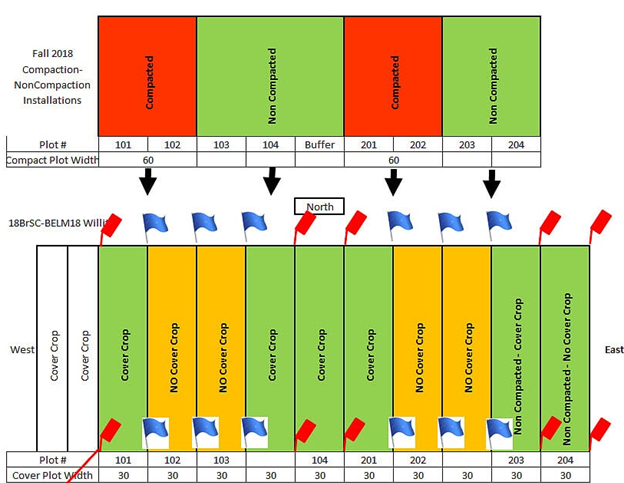
Figure 2 Cover Crop treatment blocks of equal size to the compaction plots were installed.
The penetrologgers purchased for this project were used to measure compaction with a randomized sampling scheme. The penetrologgers were used to the benefit of Ontario Agriculture by training multiple OMAFRA and OSCIA staff and contractors on their use, so that they may be used in a wide variety of projects posed to serve the Ag sector – including the ONFARM initiative.
Additionally, yield monitor data for the entirety of each plot was collected to validate the penetrologger’s detection of compaction and to demonstrate any potential impacts on yield. Samples were extracted to be analyzed at The Canadian Light Source, Canada’s national synchrotron light source facility, also to validate and provide some qualitative analysis to augment the penetrologger data.
Results
We observed no significant difference in yield response between treatments at both trials. While there was 8-9 bu/ac spread in yield between the two plots, the results indicate no statistical difference. The measured yield results suggest that no-till managed soils appear to be less susceptible to soil compaction.

We found an excessive amount of variability within each measurement, indicating that penetrologgers are likely not well-suited to measuring soil strength in poorly sorted (i.e., stony) soils. As such, we observed no statistical difference in penetrologger readings between treatments in both pots. The measured soil strengths suggest that no-till managed soils are less susceptible to soil compaction.

Figure 4 Noise in the penetrologger data made statistical analysis impossible.
Synchrotron scans have yet to be fully analyzed, but we anticipate much of the same findings.
Summary
Our findings with the compaction trials led us to observe more pertaining to the prevention of compaction, than the alleviation of it. We were also able to experience first-hand the challenges of measuring compaction, which is vital to predicting and monitoring it.
The penetrologgers were chosen because they measure soil strength. Soil strength is a strong indicator of susceptibility to compaction and can also reveal if a soil has undergone compaction. While measuring load, pressure, soil moisture or soil texture would be good predictive factors for compaction, they do not measure soil compaction directly. Much like when we call something “heavy” when other people would not; calling loads “compactive” before the soil has been compacted skews our expectations and limits our ability to make good decisions. It is important to understand the factors contributing to soil compaction as a function of the results, not just the risks.
The penetrologgers selected were the best equipment available within the applicable price-range and proved to have constraints severely limiting their utility. The GPS, mapping and data interpretation capabilities were strong features for producing great data sets. The feedback mechanisms were still not useful in allowing a wide range of users to effectively operate the penetrologgers and no number of statistical corrections could accommodate for the combination of rocks and cracks that we see in agricultural soils.
Our strongest finding is that regardless of the load and soil conditions under which one would reasonably predict compaction is taking place, compaction did not take place in these no-till trials. Unfortunately, we had not successfully installed compaction in tilled fields for comparison. However, had we installed tillage trials; we still would not have collected data that could provide insight on the impact of cover crops on compaction alleviation in no-till. While the information we found provides helpful insight on another benefit of no-till, this introduces several questions:
If the no-till soils observed showed a soil strength equal to that of compaction levels that would limit root growth, why didn’t it limit root growth?
Further to that topic, is soil strength a helpful indicator of problematic compaction or are there other factors that would explain the inconsequential soil strengths that we measured?
Finally, if we cannot always predict compaction, nor monitor it precisely – how will we manage it?