By: Emily McKague, Regional Communication Coordinator, Georgian Central Region
Is variable rate nitrogen application on corn crops something you would consider on your farm? Grey Ag Services hosted a Variability of Corn Nitrogen Response Across the Soil Landscape webinar with Ben Rosser (OMAFRA), Caleb Niemeyer (Woodrill Ltd.), Jonathan Zettler (Fieldwalker Agronomy) and Dr. Adrian Correndo (University of Guelph) on February 9th, 2024.
A major point of discussion from the webinar revolved around how to come up with rate scripts for your field. Do you match predicted yields? Do you look at field topography? How does rainfall affect prescriptions? What about using split applications?
Matching application rates to predicted yield could seem like the obvious way to begin. Higher yielding plants will require more nutrients, so it seems logical that more fertility should be supplied to those areas. Ben Rosser explained that yield actually doesn’t correlate well with fertilizer response because it doesn’t tell you how much yield comes from soil available nitrogen. When yield, nitrogen rate applied and topography are graphed, yield trends in relation to field topography but doesn’t always increase with higher rates of applied nitrogen.
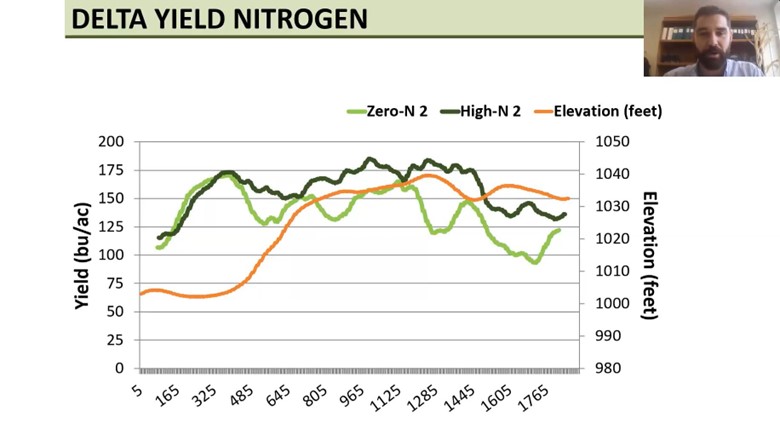
All presenters agreed that topography has a major impact on field-supplied nitrogen. Usually higher knolls are more eroded and have shallower depths of topsoil, so they have less organic matter and nitrogen available for plants. This often means a higher response rate to fertilizer applications. All the eroded topsoil (and the organic matter and nitrogen it carries with it) settles in low areas on the field, creating spots which are often higher yielding but show lower response rates for fertilizer applications. Jonathan Zettler added that regardless of nitrogen application, high knolls are at risk of runoff and low areas are prone to denitrification from sitting water, so sometimes nitrogen response (and/or yield) is low regardless of the sources supplying it.
Caleb Niemeyer noted that Woodrill Ltd. has been doing trials looking at the most economic rate of nitrogen (MERN) application using the same location, corn hybrids and management for several years. They’ve seen MERN vary from 140 – 260 kg of N/ha and found that the biggest factor influencing fluctuations in the trial is rainfall. In a high rainfall year there is more capacity for growth, which means the plants use more nitrogen to produce higher yields, so MERN goes up. He said that the most critical time for rainfall is in the V5 to V9 stages. If producers split nitrogen applications, they can gauge rainfall from the time that the corn is knee-high to six feet tall, and adjust nitrogen supplied on the second application if it’s been an especially wet year.
Jonathan Zettler also noted the importance of rainfall for yield but took a different approach to aligning crops with water supply. He said he has had success with variable rate seeding, putting lower populations on high knolls where water availability is less. He estimated a 4 – 10 bushel/acre advantage from adjusting seeding rates for slope.
Dr. Adrian Correndo shared his research on split applications and yield responses. Interestingly, he showed that yield response is only increased by split applications 10% of the time. What does improve with two applications is the stability of yield response – meaning there is less variability when nitrogen is applied twice instead of just once.
Overall, Jonathan Zettler commented that, “you’re never going to even out variability in a field, you’re just going to match fertilizer response.” Knolls and low areas will always perform differently than the more stable mid-slope but managing them well can be the difference between having a profitable crop or not.
All the presenters agreed that a producer looking to try variable rate nitrogen application should start simple. Applying less nitrogen on the low areas, and more nitrogen on the high spots is a good rule of thumb. Keep your rates simple to begin with: take an average application rate, and then set high and low rates from there, and don’t try to make your adjustment increments less than 50 lbs.