HOME PREVIOUS ARTICLE NEXT ARTICLE
By Leia Weaver, Northeastern Ontario Regional Communication Coordinator
Managing fertilizer on farms is becoming increasingly challenging, with new emission goals and rising input prices. The Canadian government has set a target to reduce fertilizer emission by 30% below 2020 levels by 2030. A common misconception is that this means farmers are expected to reduce their fertilizer usage by 30%. However, by implementing the 4R strategies to nutrient management: Right Rate, Right Time, Right Source and Right Place, fertilizer emissions can be reduced.
Peter Johnson aka “Wheat Pete” provided some insight into the issues of nitrogen (N) management to a large crowd of Northeastern Ontario growers at the recent Co-op Regionale Grower’s Day in Temiskaming. According to Johnson, most farmers tend to over fertilize with N by ~10%. The perfect rate can be difficult to determine, especially given the volatility in weather patterns.
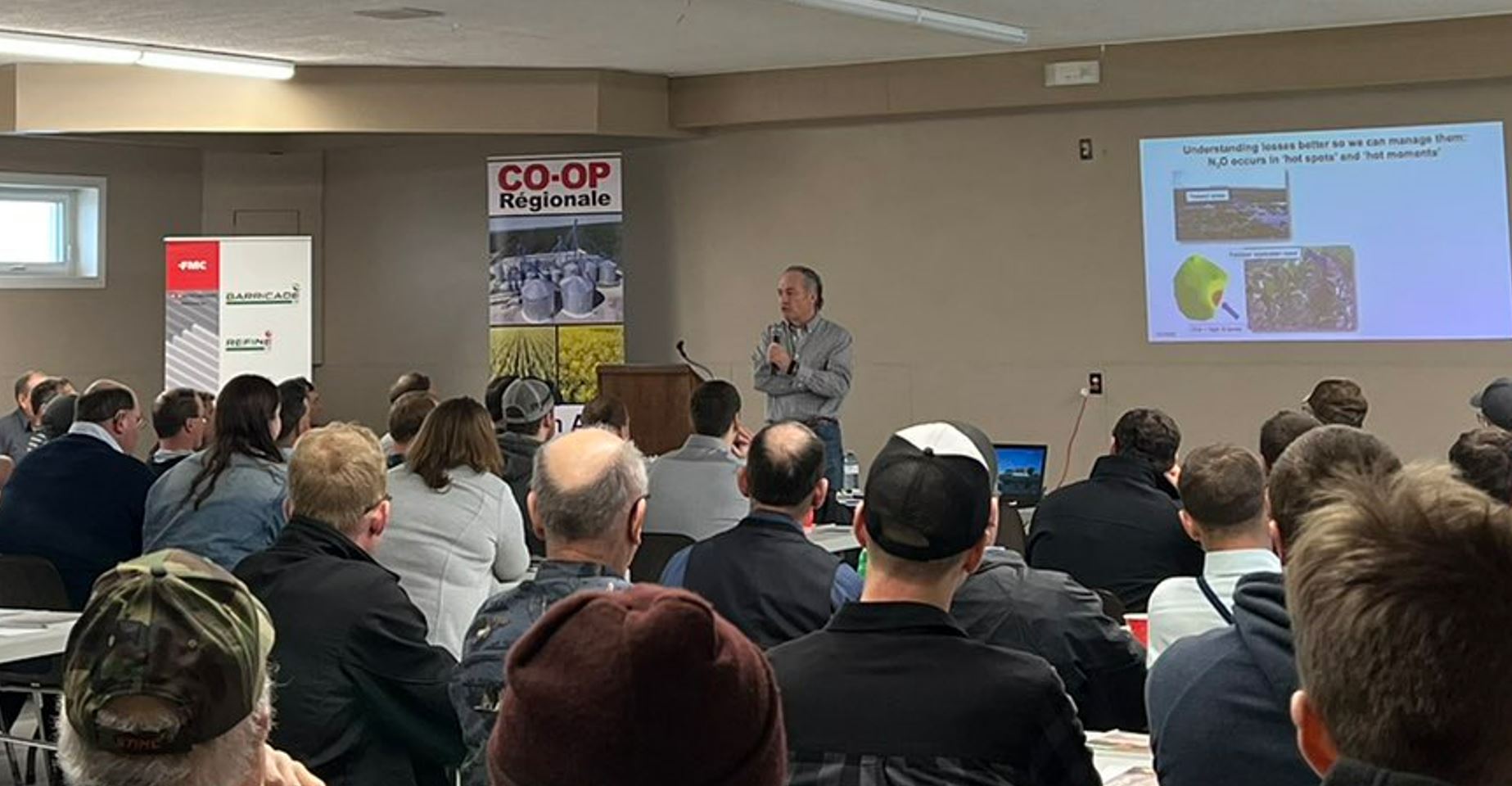
Peter Johnson presenting at the Co-op Regionale Grower’s Day (Leia Weaver).
Johnson also pointed out that although carbon emissions are also of concern, nitrous oxide is the most potent of greenhouse gases by a factor of 460 times compared to carbon. Nitrogen gas itself is 273 times more impactful compared to carbon. Some emissions of nitrous oxide do occur during spring thaw and when applying fertilizer, however, the real emissions problem occurs when microbes are given more N than they can digest when precipitation arrives post-application.
Nitrogen gas is also released from ponded, wet areas in fields. Although this is an expensive loss of nitrogen, the lack of oxygen due to full saturation of the field causes the soil microorganisms to use all available oxygen first, releasing Nitrogen gas instead of nitrous oxide into the atmosphere. Johnson highlighted that the real issue of nitrous oxide emission occurs when ammonium applied to the soil receives a one-inch rain, and the soil organisms are limited on oxygen, though not starved. When a farm receives a perfect rainstorm 1-4 weeks after planting, the nitrous oxide is released as it cannot go through the full nitrogen cycle to be converted to plant-available nitrate by the microorganisms.

Fig. 1: Nitrogen forms and pathways within an agricultural production system (Source: OMAFRA – Environmental impacts of nitrogen use in agriculture https://www.ontario.ca/page/
environmentalimpacts-nitrogenuse-agriculture)
Johnson used wheat as an example. The best way to reduce these losses is to limit the pool of ammonium, through split-applying nitrogen. Johnson recommends supplying a little at planting, then focusing the next application at stem elongation (Growth Stage 30), and hope for a rain within 4-6 weeks. If using 28% (urea ammonium nitrate), he recommends dribble banding, then applying at Growth Stage 32 to stick to the penultimate leaf to get better wheat yields. Nitrogen needs to be concentrated in spike at antithesis for the kernel set to be optimized. This way, environmental and yield losses will be reduced. If applying manure, he recommends an early starter N, then let the organic N warm up as the back-end application.
If using manure as a source of N, the soil pH must be considered, with potential for losses of up to 30% in the 12 hours after application through volatilization for a soil with a pH over eight.
Johnson suggested that cover cropping itself would not necessarily impact carbon sequestration as far north as New Liskeard, but that split-applying N to wheat could be one keyway to reduce our environmental footprint from farming.
He contrasted the Northern growing region with research from southern Ontario by Dr Laura Van Eerd on early season cover cropping. After nine years on the same site, she can now reduce applied N by 20-25%, because the carbon bank is working. But this is only with cover crops planted in July after pea harvest, and they grow until November, which is a very generous timeframe for cover crops. Carbon sequestration via cover cropping does work, long-term, but regional adaptations need to be considered to achieve real results.
Johnson ended the talk by highlighting an appreciation for manure testing. Split-N applications, along with soil testing for pH and regular testing of applied manure, can help tighten up the release of nitrous oxide into the atmosphere and help us meet emissions targets without sacrificing production.