HOME PREVIOUS ARTICLE NEXT ARTICLE
By Rachel Kehoe, Northwestern Ontario Regional Communication Coordinator
The Ontario Soil and Crop Annual General Meeting (AGM) welcomed John Sulik, Assistant Professor (Plant Agriculture, University of Guelph) and Food from Thought researcher to speak about Precision Agriculture and its many benefits, focusing on Delta Yield. He began with an overview of his current research goals while discussing what the project entails. Throughout John’s presentation, poll questions were presented with the purpose of assisting his team’s research by identifying the information that farmers see as relevant to their farm operations.
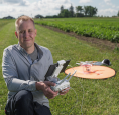
John Sulik (foodfromthought.ca)
Delta Yield describes the difference in yield between two cropping practices or treatments. In the context of Nitrogen (N) management the difference represents the gap between soil (N) supply and crop N demand. A larger delta yield corresponds with a higher N requirement. Farmers can measure the delta yield to calculate the most economic N rate and how it varies across their fields in order to understand the crop N requirements.1
Precision Agriculture provides us with the ability to understand the yield outcomes of land, establishing a foundation to make educated decisions. It enables us to reduce costs, increase profitability, enhance sustainability, and obtain better harvestability in a time of ever- increasing fertilizer, herbicide, and seed costs. With a greater knowledge of yields and soil composition, producers can accurately decrease fertilizer, herbicide, and seed rates where it would otherwise not be economical, thus reducing the input costs, and increasing profitability. This can be achieved by ensuring that input products, such as fertilizer and herbicide, get into the plants and be absorbed efficiently and effectively. Ultimately the goal is to reduce run-off into nearby rivers, streams, and lakes, creating a safer environment and reducing a producers’ carbon footprint.
Better harvestability is a significant benefit of precision agriculture. The knowledge of nutrient levels and soil types across the farm allows farmers to apply the appropriate amount of input products. This will achieve the highest yield and crop quality, while reducing costs and increasing sustainability, tying together all the previously mentioned benefits.
John Sulik and his team are researching the application of precision agriculture. The goal is to develop “standardized methods for the use of precision agriculture technologies and big data analytics when conducting rigorous field- scale, on-farm research”.2 On-farm implementation with readily available information is the primary objective of the project.
The presentation polls provided an opportunity for feedback from OSCIA members, identifying which areas of research would prove to be beneficial for producers. As well, several engaging questions were posed and answered, expressing the interest from Ontario farmers.
OSCIA is grateful for John Sulik’s time, and we look forward to following this research and the benefits to producers.
1. foodfromthought.ca/u-of-g-expert-in-precision-agriculture-to-share- insights-at-oscia-meeting/
2. Soilsatguelph.ca/projects/precision-agronomy-cover-crops-by-Soil-Type- and-the-Soil-Health-Footprint/