Written by: OSCIA provincial office Previous Next
Dan Perron isn’t afraid to try new things. As one of the first adopters of no-till seeding in Northern Ontario, he’s continually leveraging new research, innovations, and technology to improve the health of his family farm. Soil and environmental health top his list of priorities, and thanks to cost-share funding through the Canadian Agricultural Partnership (the Partnership), he was able to invest in his first no-till field equipment and retire 10 acres of fragile land.
“It’s great to encourage farmers to make environmental improvements,” says Perron. “It’s not always financially feasible to prioritize new practices or equipment, which makes programs like the Partnership such an excellent opportunity.”
A fifth-generation farmer, Perron farms with his family in Corbeil, ON, growing hay and forages for the horse feed market. A self-proclaimed wildlife enthusiast, Perron is always looking for new ways to give back to the land, and over the years he’s invested in cover crops, experimented with different rotations, and participated in tree planting programs. The Partnership program enabled Perron to purchase a used no-till drill to take his investment in soil health improvement to the next level.
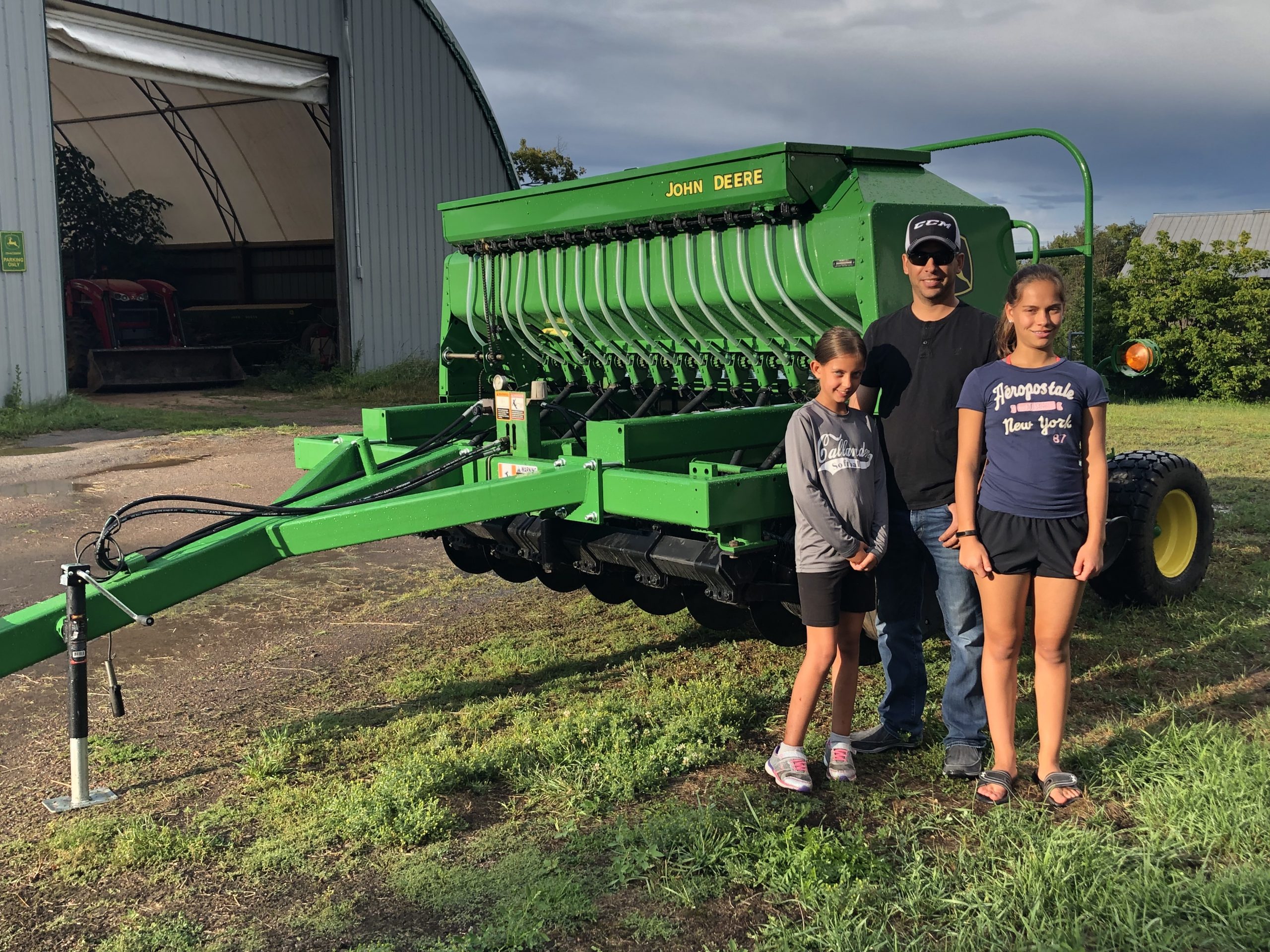
Photo credit: Dan Perron
Image 1: (Centre) Dan Perron and his daughters pose with the no-till drill he purchased second-hand with the help of the Canadian Agricultural Partnership.
“We’ve got some hard soil to work in our area of the province,” says Perron, explaining his soil conditions are a mix – ranging from heavy clay to loam. He says creating the ideal seedbed is difficult because the clay is hard to break down and prone to soil compaction, while the loam is easily eroded from over working. “I did a lot of research to determine a no-till drill would help me reduce soil disruption and ultimately reverse some of the damage being done and improve the quality. I was also looking for new ways to save on fuel and time, so investing in this new type of equipment just made sense.”
Perron says the Partnership application process was smooth and was grateful for the support available through the online application portal that allowed him to ask questions. “The cost-share program was a success for me because I was able to purchase a piece of equipment that I would have been unable to afford otherwise, and the best part is I was able to purchase the equipment used,” he explains.
Perron says he hasn’t conquered the no-till practice yet, he’s only had two growing seasons with the no-till drill, but he’s patient and continues to research new ideas. And as one of the few farmers in Northern Ontario operating no-till equipment, he doesn’t have any neighbours to go to for advice.
“I’m not scared by new ideas, and I enjoy learning from others through research and doing my homework on the internet. I’m a big believer in innovation and the need to try new methods, technology and studies,” says Perron who is also looking to create efficiencies and increase his farm’s competitiveness with the investment of the no-till drill. He believes if he can improve soil quality and improve or maintain his yields, he’ll be more competitive overall. “I’m also looking to save fuel by reducing passes across my fields, cut my labour hours and save the wear and tear on my equipment. If I can do all that while reducing soil compaction and erosion, then I’ve met my goals.”
A second successful application to the Partnership allowed Perron to retire small patches of former pastureland, totaling 10 acres, by seeding it with native grasses. Not only will the new grass areas help the soil quality and stability, but it also creates new wildlife habitats.
“I know change won’t happen overnight, but I expect the benefits of this new no-till approach to be huge,” says Perron. “It will take years to build up the soil quality, but it’s worth it.”
The Partnership cost-share funding is administered to producers by the Ontario Soil & Crop Improvement Association. The Canadian Agricultural Partnership is a five-year investment by Canada’s federal, provincial, and territorial governments to encourage innovation, competitiveness, and sustainability in Canada’s agriculture industry.